Fath’Ali Khomami Sr.: The Sufi Father of Rashti-Duzi
Fath’Ali Khomami Sr., also known as Agha Buzurg, was a devoted Sufi and a multi-talented artist whose spiritual faith deeply informed his creative output. Like a significant number of artists of the Qajar era, Fath’Ali Sr.’s devotion to Sufism guided his work; by tradition, Sufis possessed a talent for fabric patching. A native of Khomam, a village north of Rasht, Iran, Fath’Ali Sr.’s active period spanned the reigns of Fath’Ali Shah Qajar (1797–1834) and Mohammad Shah (1834–1848), coinciding with the governorship of Prince Yahya (son of Fath’Ali Shah) in Gilan.
The political stability and flourishing of artistic expression under Fath’Ali Shah Qajar — driven by the Bazgasht (return) movement to revive the artistic glories of the past and patronize diverse artists — set the stage for Fath’Ali Sr.’s genius. As a creative artist operating during this era, he deeply understood the tragedies of the Russo-Persian Wars and captured them powerfully in his work. This period also marked a revival of Sufism. Fath’Ali Sr. operated in the trade hub of Rasht, a city with a diverse population of indigenous Gilaks, immigrant Turks, Armenians, and a small Jewish community. The city offered professional silk dyers and imported European flannel, but the most important aspect of creating Rashti-Duzi was Fath’Ali Sr.’s individual creative mind.
Fath’Ali Sr. is historically credited as the creator and father of Rashti-Duzi, as no surviving pieces predate his work. Prior to his creation, the local craft consisted of silk embroidery on felt, but none of those older works possessed the distinct characteristics of Rashti-Duzi. Fath’Ali Sr. began his embroidery as a simple but creative patchwork and single-handedly advanced the medium into an elaborate, artistic textile. He initially utilized cheap, olive-green flannel imported for military uniforms as a base fabric, but soon transitioned to high-quality flannel imported from Denmark and England.
Beyond textile art, significant evidence indicates Fath’Ali Sr. was a prominent contemporary painter and potentially a stained glass designer. Today, his signature survives on one of two Rashti-Duzi royal tents housed in the Cleveland Museum of Art. He passed his skills down to his son, Fath’Ali Khomami Jr., also known as Agha Koochek, who pursued an artistic career following his father’s exact path. However, Fath’Ali Sr.’s personal biography — including his birth, death, and social life — remains unrecorded and warrants further historical investigation.
Unfortunately, because his pieces were made of wool, the passage of time and the unfavorable climate of Gilan (high humidity and moths) have caused significant damage to his historical works. The earliest Rashti-Duzi pieces in my personal collection are his works, which will be presented later. Through a closer examination of his remaining pieces — including surviving works from my personal collection and other public examples — we can fully appreciate his exceptional vision. These artifacts reveal that in various creative and technical aspects, Fath’Ali Sr. was far ahead of his time, earning his rightful place in Persian art history as the father of a creative new art form.

How to Recognize Fath’Ali Sr.’s Panels
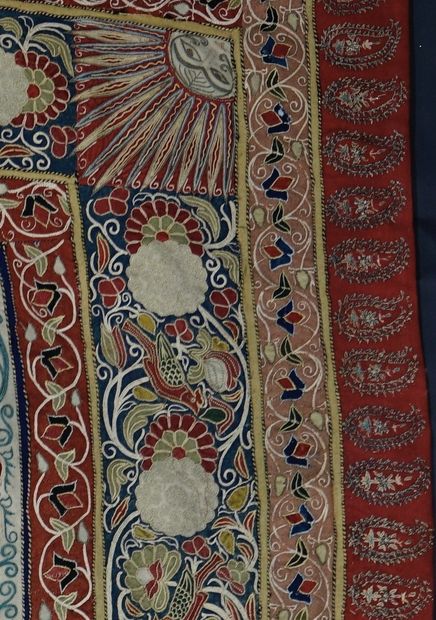
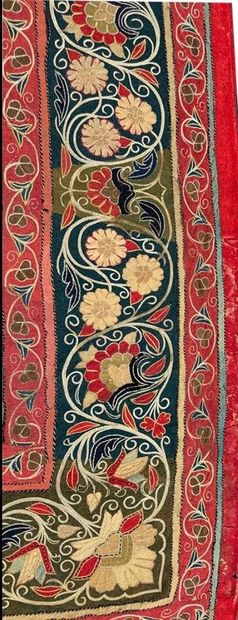
So far, I have only found one Fath’Ali Sr. signature in his works: the Royal Tent in the Cleveland Museum of Art. However, by comparing several panels of the Royal Tent with existing Qajar-period Rashtiduzi, we can find significant similarities with other panels. In these, we see repeated symbols, motifs, and designs in common with the Royal Tent.
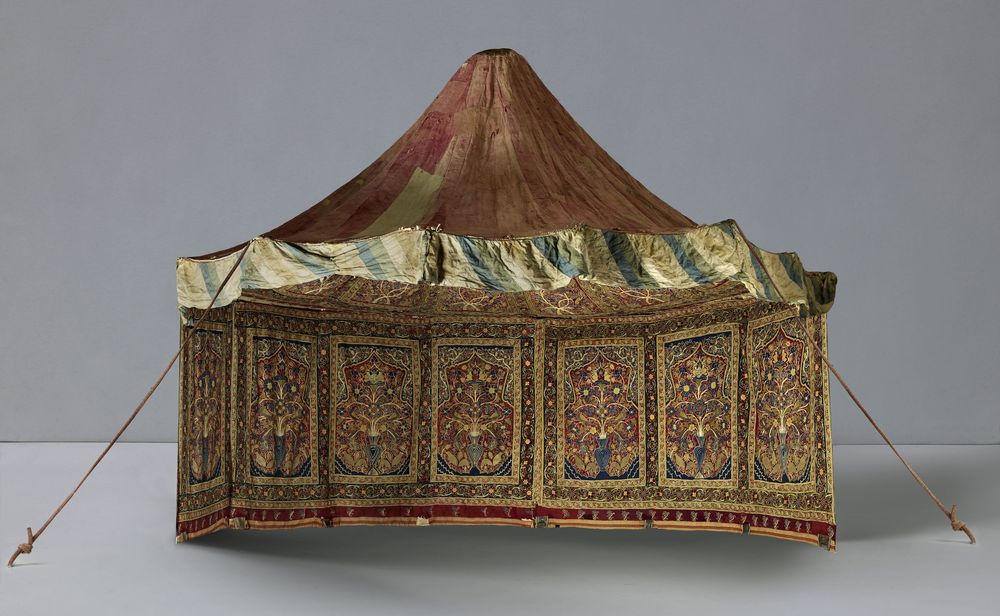
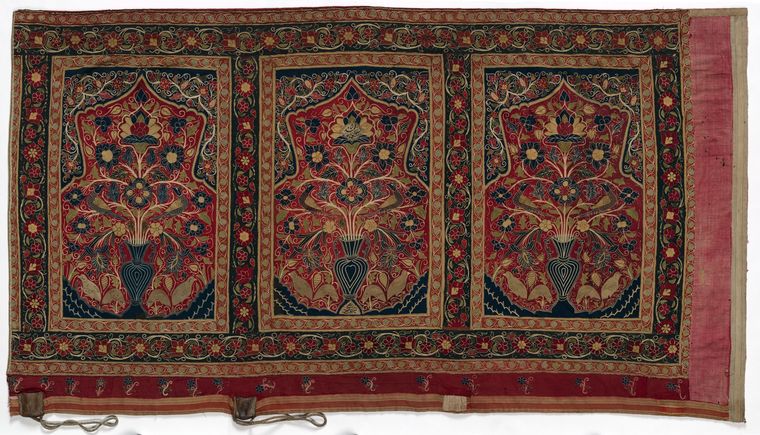
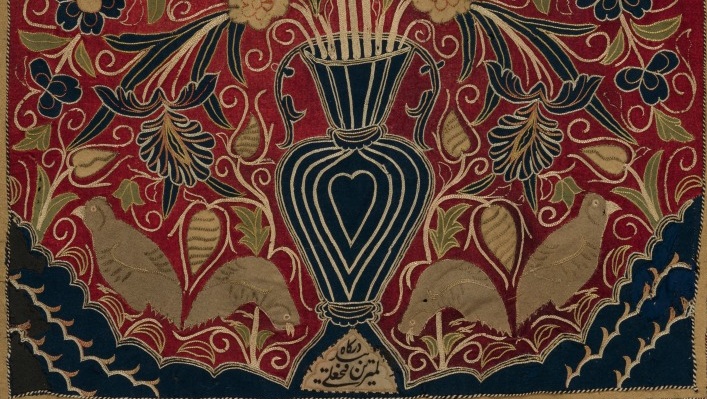
- Almost all panels by Fath’Ali Sr. are wall hangings, except for the panels of the tents (which are similar to paintings).
- Repeated use of certain designs in the borders, inspired by Safavid period designs.
- Often uses the number three (such as three different flowers or motifs).
- Extensive use of Sufi mythology symbols and symbols from the poems of Iranian poets like Attar, Rumi, Jami, and Ferdowsi.
- Significant influence from stained glass designs.
- Only occasional use of paisley motifs in the borders of the panels.
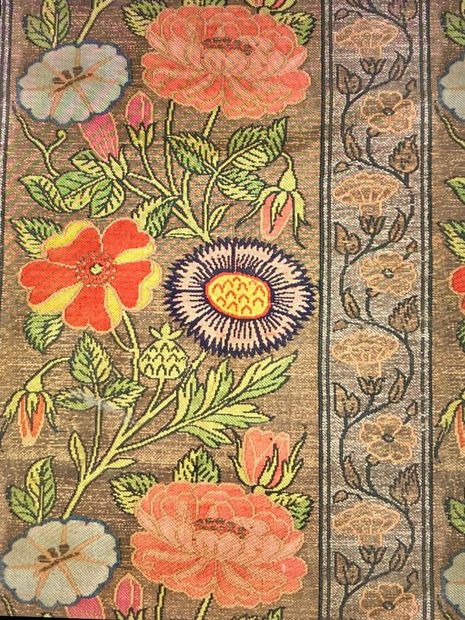
Recognizing an Unsigned Master
There are significant similarities in the portrait paintings of the early Qajar period, especially in the foreground and background. It appears that most of them came from one school. For this reason, recognizing a painting’s artist without a signature becomes difficult. But most artists developed certain clues that make recognizing those artists’ works more possible.
In Fath’Ali Sr.’s case, there are certain elements that may make his artwork more recognizable:
- Frequent use of the number three in his portrait paintings (in the crown, sword, dagger, the ornamented areas of the clothing, and some other objects in the painting).
- In the foreground mat or carpet, the rose motifs are more delicate and colorful, and are often copied from his Rashti embroidery work.
- In the portrait paintings, there are objects or writings that explain the character of the subject.
- There is no erotic or exposed area of the body, except the hands and feet (at least, I have not seen any in my findings).
In my opinion, the artistic value of Fath’Ali Sr.’s work in Qajar art history has to be recognized. The extent of that value depends on the results of further research.
Conclusion
Fath’Ali’s Legacy
Fath’Ali had every quality needed to be a great artist of his time: he created a new art form, developed a new style, possessed exceptional skill in both Rashti-duzi and painting, expressed important historical events, created new concepts and motifs, and worked across a wide range of artistic expression.
The Creation of Rashti-duzi
All the evidence indicates that Fath’Ali created Rashti-duzi, as no textile with the characteristics of Rashti-duzi exists prior to his work. He most likely created it for several reasons:
- By using Sufi symbols, he could open up more space to express his thoughts than painting allowed.
- To create a new, original Persian art form.
- To reduce the risk of detection and harassment. Compared with paintings, Rashti-duzi panels are lighter and more easily stored, hidden, and transported over long distances — and because of their heavy Sufi symbolism, they are difficult for anyone but Sufis to understand.
New Concepts and Motifs within the Frame of Persian Art
He used historical events effectively to express the feelings of the nation and his own (as in the panel The Tragedy of War and Hope). In that same panel, he portrayed fallen red tulips as fallen heroes, much as Ferdowsi did with the death of Siyavash. Looking closely at the panel, we see how he used color and new motifs to convey his feelings and thoughts: he gave the tulips a sense of motion — a field of tulips swaying in the wind — by rendering them in many different shapes.
His ideas of drawing the viewer into his art, of who you are, not how you look, and of creating an orchard or rose garden within a stained-glass window, all expressed through the originality of Persian art — all of these were progressive and new.
He drew on Persian literature and poetry to express symbolism and deeply thoughtful ideas.
He created multimedia textile portraits (multimedia collage Rashti-duzi). As far as I know, Fath’Ali was the first artist to create this style in Persian art, as seen in the portraits on the royal tent and in the portrait of the Christian maiden from the story of Shaykh San’an. We can appreciate the skill, execution, and beauty of these panels. For this reason, Rashti-duzi portraits deserve to be presented as painted portraits were — as a new form of artistic portraiture in the early Qajar period.
I believe that, with further research and historical study of his work in painting, Rashti-duzi, and perhaps stained-glass design, he will come to be recognized as a great Persian artist of the Qajar period, and possibly one of the finest Persian artists of the 19th century.
My only regret is that he was not recognized earlier, when he might have become a mentor to future generations of artists — except in a few instances, such as his son, Fath’Ali Jr., and Haji Turab, who followed his style and ideas.
Fath’Ali Sr. as a Painter
My argument that Fath’Ali Sr. was not only a master embroiderer but also a prominent painter — the visual evidence, and why his work has gone unrecognized.
Read the case in “Fath’Ali Sr. as a Painter” →