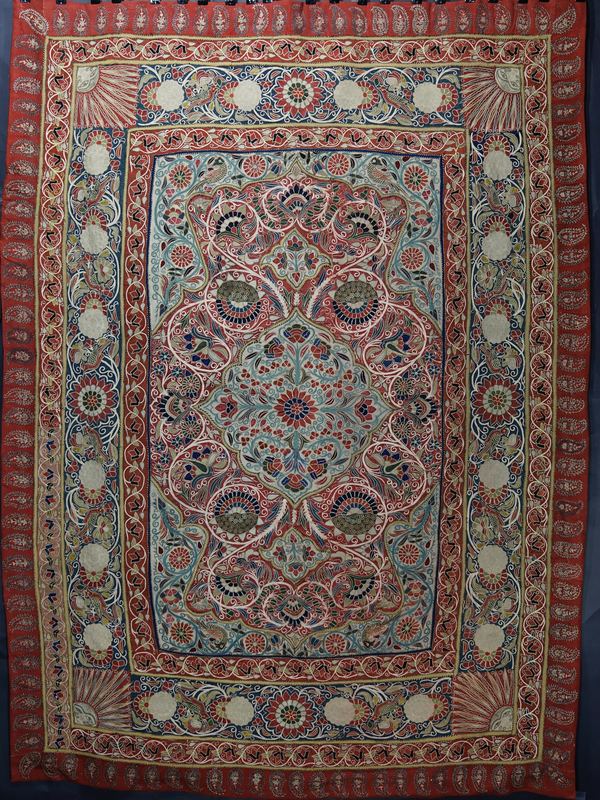
Flannel base · silk embroidery · Type One Embedded · silver thread Zarduzi (end borders)
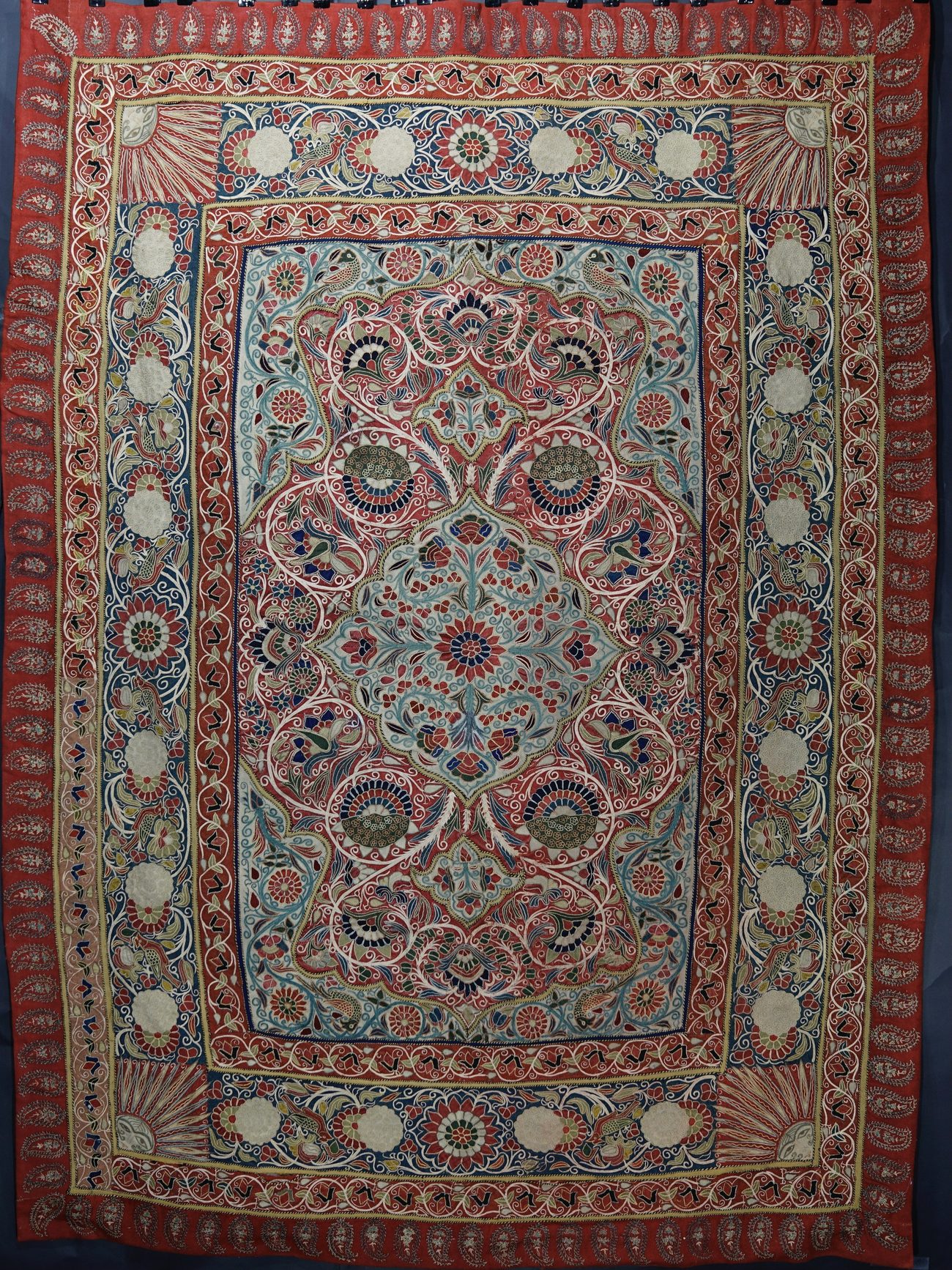
Considered one of Fath’Ali Sr.'s most creative works and a standout of the Qajar period — introducing a surrealistic symbolic portrait approximately 100 years before Europe arrived at the same idea.
🌟The only known surrealistic portrait in Rashti-duzi — expressing not how a person looks but who they are. A revolutionary concept in Persian art, a century ahead of its Western equivalent.
Overview
A Face Made of Symbols
From the end of the 17th century through the 19th, the history of Iran and the Ottoman Empire saw repeated periods of severe persecution and massacre of Sufis. One of those who were killed was Nur Ali Shah, a very prominent young leader in Sufism, poisoned and murdered in 1797 CE. In this panel, Fath’Ali Sr. presents him as one of the holiest figures in Sufism.
As far as I know, there is no portrait of Nur Ali Shah made from life. Every portrait of him rests on written descriptions of his appearance: a small mouth, very attractive eyes, and long hair — which is why his likeness varies so much from one artist to the next. Fath’Ali Sr. set that problem aside by creating a surrealistic image that emphasizes his character rather than his looks. Showing who he was rather than how he looked was — and still is — a revolutionary idea, and Fath’Ali Sr. presented it some 200 years ago.
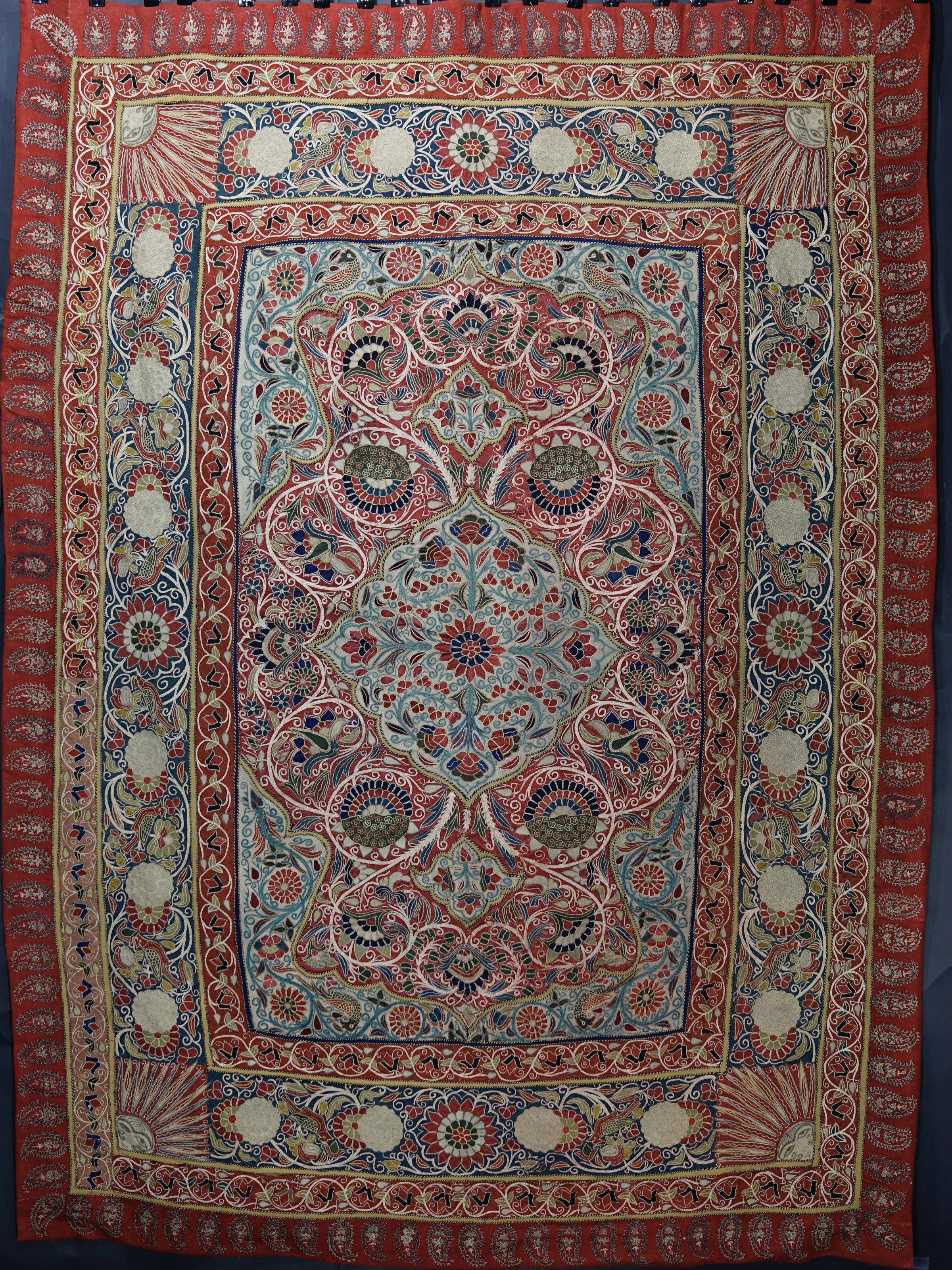
The panel is arranged in five sections, each presenting a different aspect of Nur Ali Shah’s standing. It is designed like a stained-glass window for a house of worship, built around three dominant colors: red (martyrdom), blue (mourning), and white (purity and peace).
Section one — a surrealist face, with a crown and two prominent eyes made of flowers (rose and jasmine), three red and blue tulips, and long hair falling on either side of the eyes. Every symbol here speaks to his character and his martyrdom.
Section two — the medallion, symbolizing his devotion to the divine, the extent of his knowledge, and his martyrdom.
Section three — the two sides of the image, an eulogy for his life.
Section four — the borders. The three outer bands carry the tulip (martyrdom); the middle band, with hoopoe birds, roses, and jasmine, describes his achievements as a leader, a messenger, and a sun illuminating the world.
Section five — a paisley Zarduzi worked in silver thread, surrounding the panel like a shining halo and giving it a strong sense of holiness.
Presented in full, this panel would need a whole chapter to explain; I will return to its most important aspects later. In skill, creativity, and execution, it is very likely a masterpiece of Fath’Ali Sr.’s work.
Click to enlarge
Nur Ali Shah was said to have hypnotic eyes; Fath’Ali Sr. renders them as jasmine and rose, and crowns the face with a single tulip shaped as the word Allah.
The highest symbol in Fath’Ali Sr.'s vocabulary, placed where the crown meets the heavens
Brief history of the persecution and massacre of Sufis in the late 17th, 18th, and 19th centuries
Even though the Safavid dynasty was established by a Sufi family, with the passing of time Sufis were harassed and persecuted. The persecution got worse at the end of the 17th century and continued into the beginning of the 18th century. During the mid-18th century there was a short period of relative tolerance under the Zand dynasty in the city of Shiraz, which became a sanctuary for Sufis. But after the death of Karim Khan Zand, the harassment and persecution resumed. At the same time, Sufis were also harassed in the Ottoman Empire. One of the high-ranking young Sufis who was persecuted was Nur Ali Shah.
Nur Ali Shah was born in Isfahan. As a teenager he studied mathematics and science, but he soon changed his mind and, with the help of his father, who was a Sufi, started studying Sufism and theology. He reached the highest rank in Sufism at an early age. Due to harassment he moved from the city of Shiraz to the city of Karbala, and then to Mosul. There he was poisoned and murdered in 1797 CE. He was a poet, writer, and theologian, and he wrote five books of poetry and theology.
During the 19th century there was some tolerance at the Qajar court, specifically during the rule of Mohammad Shah and Nasser al-Din Shah. In this period Sufi artists glorified the Sufi martyrs through their artwork.
The design of the panel
The panel is designed to look like a stained-glass artwork for a place of worship, in three colors: red (martyrdom), blue (mourning), and white (purity and peace). It is divided into five sections:
The surrealist image, in which the symbols explain who he was (the concept of who he was, not how he looked).
The medallion, which explains his education, his knowledge, and his role as a wise man and teacher.
The two sides of the surrealist image, which explain his life (a eulogy).
The main section of the borders, which explains his achievements.
The last section of the borders, a paisley Zarduzi in silver thread, which symbolizes his holiness and glows like a halo to create a feeling of sainthood.
I will be brief in explaining the symbols, because explaining them in detail would need a whole chapter.
Section one (Character) – The surrealist image of Nur Ali Shah
At the top there is the image of a crown with three motifs. The middle one, which shows multi-level flowers, symbolizes the pomegranate flower in seven stages of blooming, a metaphor for the seven stages to reach annihilation (fana). Above this symbol is an unopened tulip, a sign of the divine. On the two sides of the symbol are two bunches of grapes, a sign of intoxication. This symbol means that he (Nur Ali Shah) passed through the seven stages of purification of the ego and reached the highest level of purification.
Below the crown, in the middle, is a broken heart from which a stem rises with three blue and red tulips, symbolizing martyrdom and mourning.
The two eyes are made of rose and jasmine in blue, red, and white. The two fragrant flowers combined have a profound meaning. The rose means divine love, leadership, and going through hardships to reach the goal. The jasmine means purity, and becoming more resilient when going through hardships. The fragrance means attraction. The combined motif means a person with attractive eyes who went through hardship to achieve the highest purity and became more resilient under harassment.
Section two (Knowledge) – The medallion
In the center there is a rose, a symbol of divine love, surrounded by fully open pomegranate fruits and pomegranate seeds, which symbolize reaching the highest level of knowledge (a wise man) and teaching. Three pomegranates rising from one stem, in red and blue, with five stages of blooming, are a metaphor for going through all the stages of learning. A single fully blossomed pomegranate in red and blue indicates a high-ranking leader of knowledge (Morshed). The medallion explains that he went through several stages of divine education, reached the highest level of knowledge, became a high-ranking educator, and spread his knowledge all over.
Section three (Eulogy) – The two sides of the crown
On both sides of the crown, from bottom to top, a path starts from a blue broken heart and divides into two paths. One passes through three red roses. The other goes through a tulip shaped like a cup, then a silent bird in red and blue, and ends at a blue and red flying swallow.
Blue means mourning; red means martyrdom. The section explains, with sadness and a broken heart (the blue broken heart), that a highly divine lover (the three red roses) was poisoned (the tulip cup), passed away (the silent bird), and returned to the permanent nest (the flying swallow), and was blessed by God (the shining sun in the corners).
Section four (Achievement) – The main borders and their two sides
This section is about his achievements and martyrdom. There are hoopoe birds alternating with combined rose and jasmine motifs. Above each hoopoe there is a rose or an iris flower. In the center there is a shining sun.
This section describes Nur Ali Shah as a messenger and leader (hoopoe, rose, iris) who went through hardships and harassment, became more resilient, and whose knowledge spread and illuminated the world.
Section five (Halo) – The Zarduzi border
The paisley Zarduzi in silver thread makes a shining, reflective border surrounding the whole panel like a halo, which gives the panel an expression of holiness.
The Swallow in Iranian Tradition
The swallow is a sacred bird in Iran. It lives here through spring and summer, then migrates south in mid-autumn and winter. Pilgrims traveling to Mecca in winter would see swallows around the city and believed the birds, too, had come on pilgrimage. For this reason, in northern Iran the swallow is called hajhaji — “the bird that makes the pilgrimage to Mecca.”
When I was in high school, I often went out to the rural areas of Gilan to visit farmers, and one of the scenes that stayed with me was the nesting of the swallows. They were a sign of good luck, and the farmers welcomed their return with joy — it came at the time for planting the rice seedlings. The calls of the swallows and their chicks were music to the farmers’ ears.
Barn-swallow chicks in the family nest, built from clay and straw. (Click to enlarge)
Each returning pair comes back to its old nest to clean and repair it, while the young birds hatched the year before build new nests from clay and straw — the clay shaped with their saliva, the straw worked in to make the nest strong. For each pair the nest is permanent: every year they return, repair and clean it, and raise their young in it.
The flying-swallow motif in this panel — a symbol of return and of the permanent nest — draws on this genuine Iranian tradition, and adds to the panel’s originality.
Conclusion
This panel is probably a masterpiece among Fath’Ali Sr.'s works from the standpoint of skill in panel making, creativity, and execution. The surrealist image, the division of the panel into sections like the chapters of a storybook, the eulogy section, and the Zarduzi in the borders were all progressive and new for that time, and still are.
Comparative Works
From Likeness to Soul
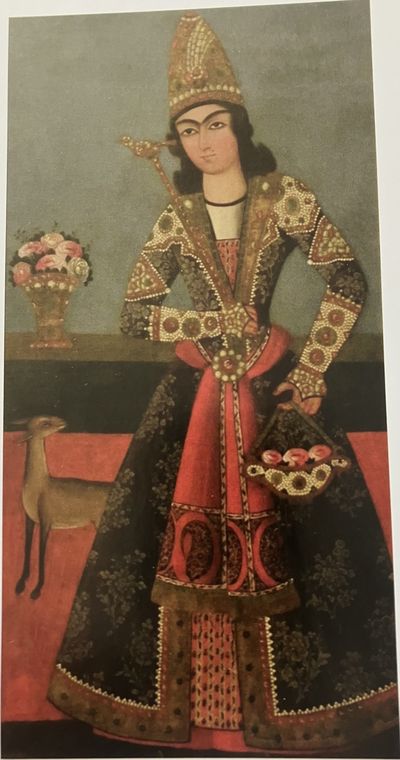
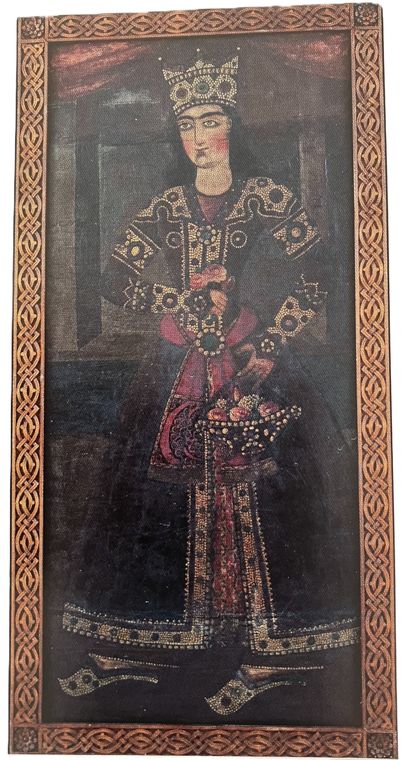
Probably three portraits of Nur Ali Shah, marking three different periods of Fath’Ali Sr.’s career. The first is a simple portrait showing Nur Ali Shah with a deer — reflecting that both are victims of cruelty, self-interest, and self-satisfaction. The second shows Nur Ali Shah raised above life, as a king. In the third, there is only a surrealist image, which explains who he was, not how he looked — another example of how his thought evolved over time.
A simple standing portrait — with the deerRaised above life — as a kingA face made of symbols — the surrealist panel
Essay
A Portrait of a Soul
Listen
This panel commemorates Nur Ali Shah, a Sufi master, in a portrait Fath’Ali Khomami Sr. made decades after the man’s death. It is unlike any other portrait, because no likeness of Nur Ali Shah was ever drawn from life. His appearance survived only in description — a small mouth, striking eyes, long hair — and every artist who worked from those accounts produced a different face.
Fath’Ali Sr. declined the attempt. Rather than reconstruct an appearance he could not know, he chose to portray not how Nur Ali Shah looked, but who he was. The result, worked in silk and silver thread on flannel in a Rasht workshop in the 1840s, is a portrait built entirely from symbols. It is a face only in the loosest sense: the eyes are rose and jasmine, and above the head a single tulip takes the shape of the word “Allah.” Each feature stands for a quality, a stage of spiritual attainment, or a reference to the man’s martyrdom. This is what sets the panel apart. The idea of a psychological portrait — the face as an interior landscape rather than a surface — would not appear in European art until the Surrealists of the twentieth century. Fath’Ali Sr. reached it a hundred years earlier, from within the Sufi tradition.
The subject merited such ambition. Born in Isfahan, Nur Ali Shah left the study of mathematics for Sufism and theology as a young man and rose to the highest rank of his order while still young. He was a poet, writer, and theologian who left five books. He was also a hunted man, for Sufis were persecuted across Iran and the Ottoman world; he was driven from Shiraz to Karbala and finally to Mosul, where he was poisoned in 1797.
Fath’Ali Sr. tells this life in five sections, arranged in sequence like the chapters of a book and colored like stained glass for a place of worship — red for martyrdom, blue for mourning, white for purity. The central section is the symbolic face, its crown and flowers describing a man who had passed through the stages of purifying the self. A medallion speaks of his learning and his role as a teacher. Down the two sides runs a eulogy, read from the bottom up: a broken heart, roses, a poisoned cup, a silent bird, and finally a swallow in flight — the soul returning, as swallows return each year to the same nest. The borders record his achievements, and an outer band of silver paisley encloses the whole like a halo, lending it an air of sainthood.
Holding all of it together is a single, quietly radical conviction: that the truth of a person lies not in appearance but in character. Fath’Ali Sr. had no likeness to copy and did not pretend to one. He gave us instead a spiritual biography in thread — a field of meaning that rewards slow reading rather than a passing glance.
In skill, invention, and execution it is very likely his finest work. Its deeper significance is historical: an idea we think of as modern — the portrait of an inner life in place of a face — was already fully realized, two centuries ago, in a workshop in northern Iran.