“The vase and the body are made of the same four elements: soil, water, fire, and air. To understand one is to understand the other.”
Inspired by Omar Khayyam — the source Fath’Ali Sr. draws on for the vase symbol
A Detailed Reading of the Panel
The Structure of the Panel
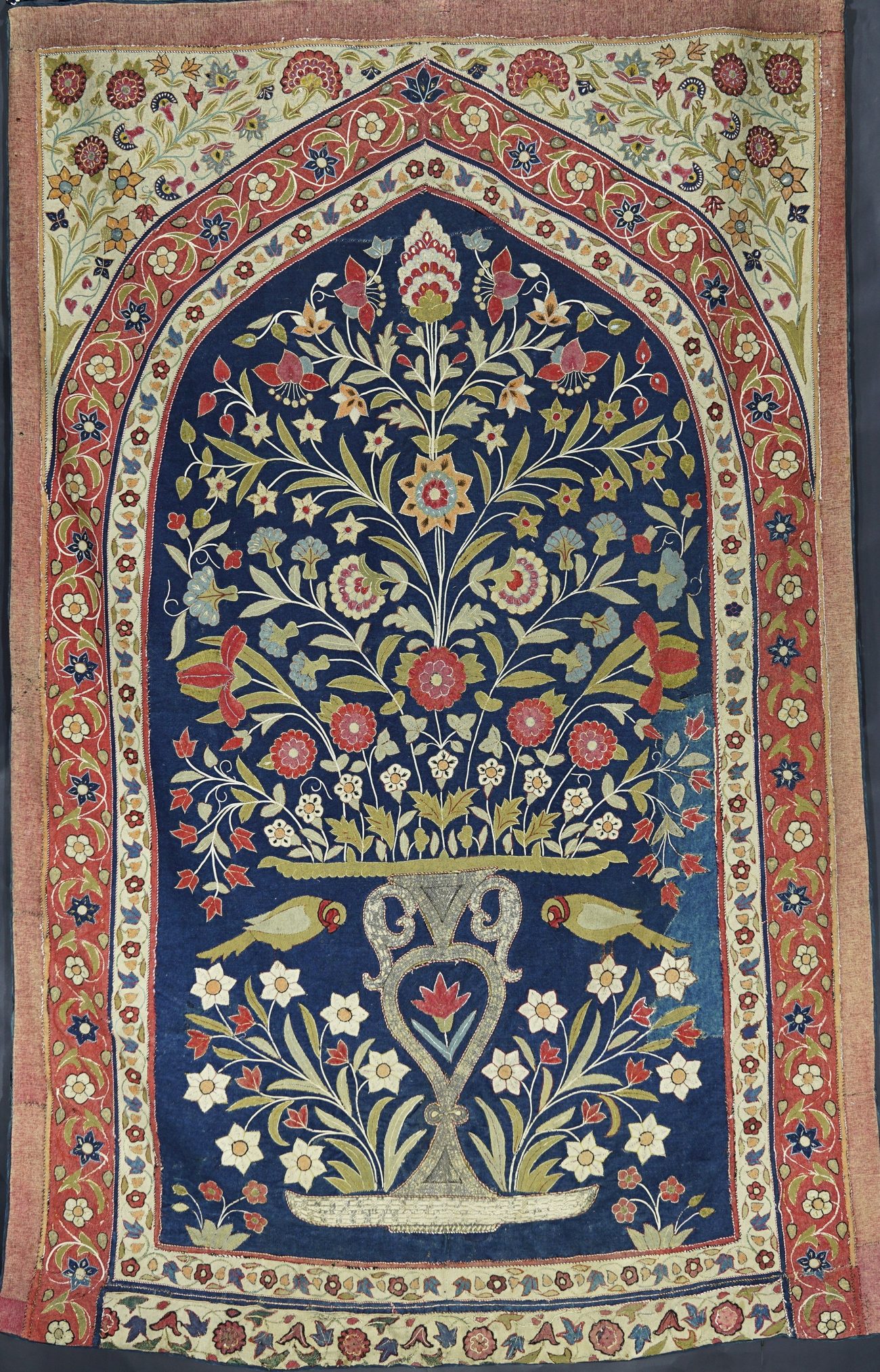
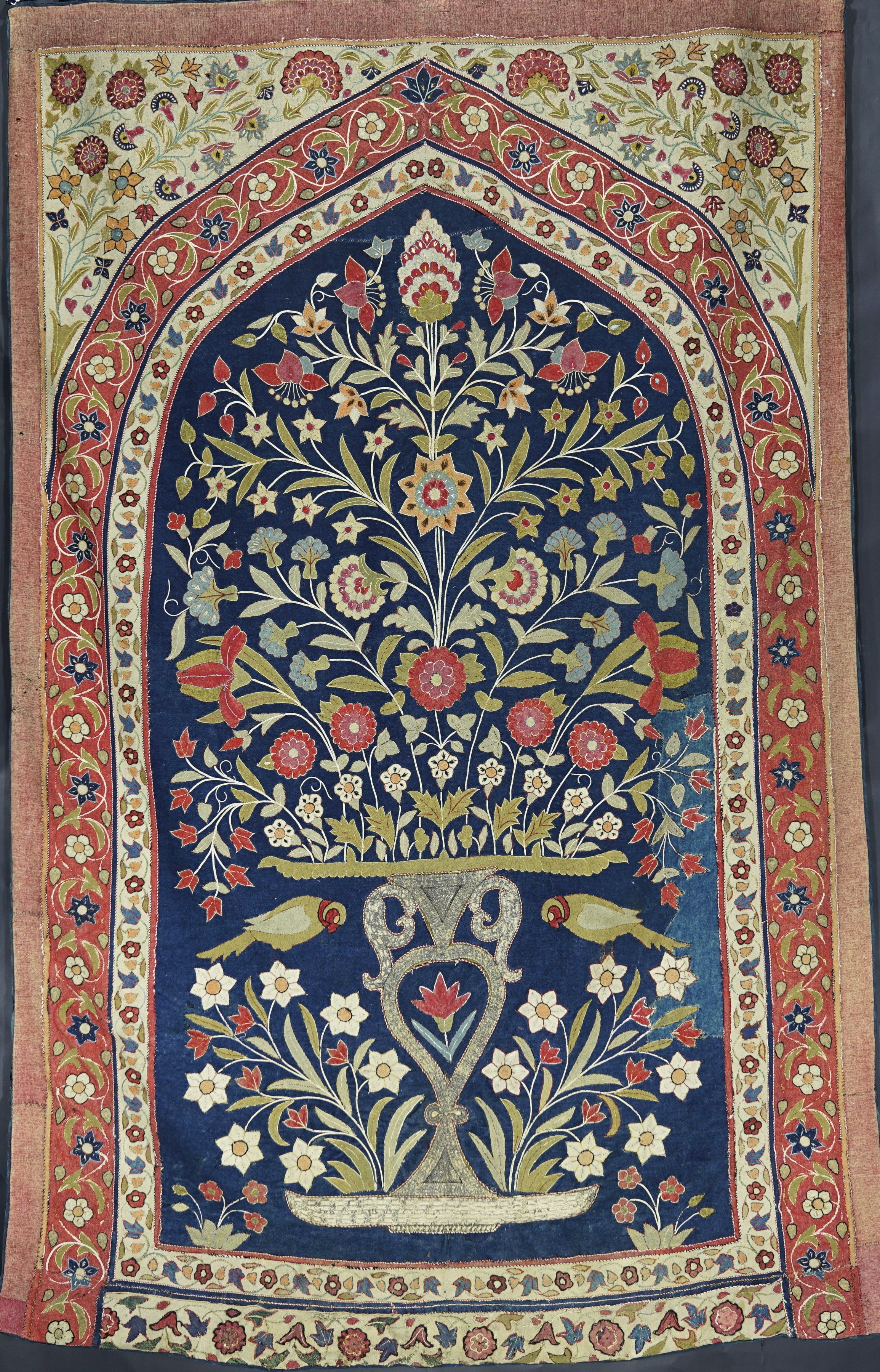
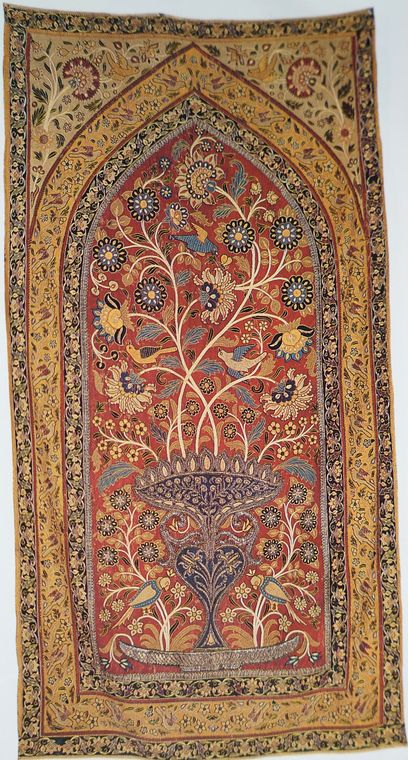
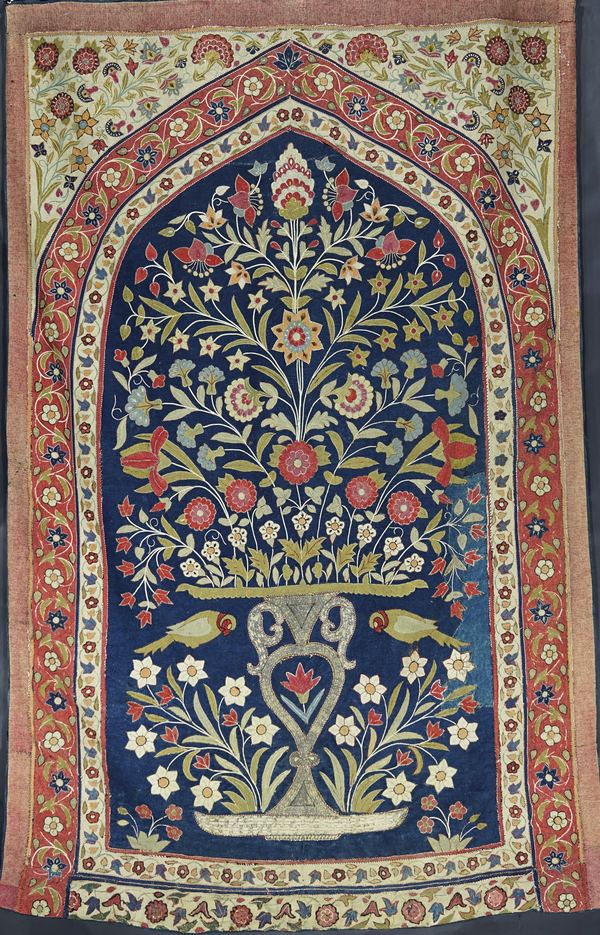
The panel is divided into two sections: the main section, and a small annex on each side at the top, together with the borders. The main section is itself divided into two parts — the lower third and the upper two thirds.
The Lower Third — Earthly Objects
The lower third contains eight flowers, two parrots, and a vase. These are all earthly objects and indicate low spiritual significance. They are read from bottom to top.
The Flowers and Their Meanings
Each flower carries meaning in Sufi symbolism. I explain them here in more detail, as a reference for the rest of the panels.
- Violet — the posture of humility. Violets grow low to the ground and tend to bow their heads, hiding beneath their heart-shaped leaves — an image of ego-less submission and true humility before the divine.
- Narcissus (daffodil). The narcissus carries several meanings in poetry and in these panels — selfishness, humility, beautiful eyes, divine vision and insight, or the triumph of spiritual renewal. In this panel, because of its location, it leans toward spiritual humility and self-negation rather than its usual sense of selfishness.
- Bowing tulips. Some flowers carry different meanings at different stages of blossom — an evolution that matters most in tulips, roses, and pomegranate flowers. A tulip begins as a bud close to the ground, rises into full bloom, then bends back toward the ground. An early-blooming tulip stands straight and resembles alef — the first letter of the Arabic alphabet, and the first letter of "Allah" — so it carries strong spiritual significance. In half-bloom it signals transition. In full bloom, seen in profile, it resembles the written word "Allah"; and in Persian the tulip's name, laleh, shares the same letters as Allah — giving it the highest spiritual meaning. In the bowing position it has the least spiritual significance, meaning humility. The narcissus and tulip sometimes appear together, their meaning depending on the tulip's stage — for example, a bowing tulip beside a narcissus expresses two opposite pulls: humility (the tulip) and selfishness (the narcissus).
The Parrots
In The Conference of the Birds, by the 12th-century Iranian poet Attar, the parrot is a bird that lives long and has no desire for spirituality — content with its life even inside a cage. It symbolizes earthly life and attachment to the material world. For this reason, in most of the panels the parrot looks downward, toward the ground.
The Vase
The vase is a symbol of the body (zaher). The full-bloom tulip inside it is the hidden desire of the soul to express itself.
The vase in Iranian art and poetry. Making a ceramic vase or pot requires four essential elements — the same four present in every living creature: earth (clay), water, fire, and air. The vase is made of clay, shaped with water, and baked by fire, and fire needs air to burn. The 11th-century Iranian poet Omar Khayyam likened pots and vases to human beings in his poetry.
In making the vase, Fath’Ali Sr. used silver thread instead of silk, to create a reflective, mirror-like surface. (That reflective quality is now significantly compromised by age and oxidation.) When viewers look at the vase, they see their own image in it — telling them that the symbol of the vase is you. Fath’Ali Sr. created this concept two hundred years ago, a mark of his exceptional creativity. In recent art we see the same idea — for instance, "the Bean" (Cloud Gate) in a Chicago park.
The Upper Two Thirds — Flowers from Bottom to Top
Here I describe the flowers as symbols, from bottom to top, in brief; each is treated more fully in its own panel. As noted, the transformation of certain flowers from bud to full blossom — along with their color, location, and combination with other flowers — changes their symbolic meaning.
- Cherry / fruit-bearing blossoms (five petals, white, purple, or pink). Cherry blossoms open in early spring and their petals fall quickly, symbolizing something short-lived, a beginning, or a beginner — and also a child. Ripened into fruit, it means something sweet and beautiful.
- Hanging tulips. Humble and indecisive.
- Rose. A sacred flower whose meaning shifts with its color, stage of bloom, location, number, and pairing with other flowers. The most common are the divine beloved and the paradox of love and pain (the thorns are pain and hardship); it also means love, the leader, and the lover.
- Iris. Messenger and connector.
- Carnation. Endurance — the carnation lasts longer than any other flower in the vase.
- Early-blossom pomegranate. A beginner, a seeker.
- Rose (in profile). The rose shown from the side.
- Jasmine. For its fragrance, it represents the intoxication of divine union and purity of heart. It usually appears in two colors: blue — the spirit of the jasmine — meaning intoxication; and white, meaning purity. When jasmine is pressed, more fragrance is released — symbolizing a person who grows more resilient through hardship.
- Sunflower. In bloom, absolute devotion (the sunflower follows the sun regardless of the weather). Ripe, heavy with seeds and bowed, it is a humble wise man ready to spread his knowledge. The ripe, open pomegranate fruit carries the same meaning.
- Full-blossom tulip. A sacred flower. In Persian the tulip is laleh, sharing its letters with Allah in Arabic; the shape of a full-blooming tulip in profile also resembles the Arabic writing of "Allah" — God.
- Full-blossom pomegranate. A sacred flower meaning divine love and the seeking of unity — the highest spiritual significance. The tulip, pomegranate, jasmine, and grapes stand at the highest spiritual rank. A full-blossom pomegranate also means the beloved.
- Seven-layer pomegranate crown. The flower crown in the top middle of the main panel is made of seven layers of pomegranate flower in different stages of blooming — a metaphor for the seven stages of the journey from a hidden desire toward purification. Another flower crown sits at the top middle of the side panel.
- Five-layer rose crown. The side-panel crown is made of five layers of roses in different stages of blooming, representing the five stages of training under a master teacher (Morshed, or pir) on the way to unity — enriching the soul through knowledge.
- Evolution. Across the panel, the imagery evolves from simple to complex, with the motifs arranged from the lowest to the highest spiritual standing.
The Two Top Sides
The top side panels repeat the spiritual ranking of each flower from bottom to top; the only difference is that most flowers are shown in profile (each flower seen from both the front and the side).
The Borders
The borders alternate pomegranate flowers with cherry blossoms — the cherry blossom as a beginner (a seeker), and the pomegranate as the teacher who guides the seeker on the journey toward unity. In another section of the border, cherry blossoms alternate with tulips, carrying almost the same meaning: morid and morshed (disciple and master).
The Mirror in Iranian Tradition
The mirror, as a reflective household object, has deep roots in Iranian tradition. At a wedding, once the marriage is performed, the bride lifts the veil from her face and sees herself for the first time in the mirror — with new makeup and a new look — and recognizes herself as a new person, with a new life, new relationships, and new responsibilities. In the Persian New Year setting (haft-sin), a mirror is essential. Elaborate mirror-work adorns the rooms of palaces, mosques, shrines, and the houses of the wealthy, and is part of Iran’s architectural heritage. Decorating the back of a mirror as a work of art was part of Qajar artistic culture. All of this reminds us of the special value of the mirror in Iranian tradition.
By adding a mirror to his work, Fath’Ali Sr. created a motif that brought the viewer into the artwork — and deepened its originality as a piece of Iranian art.
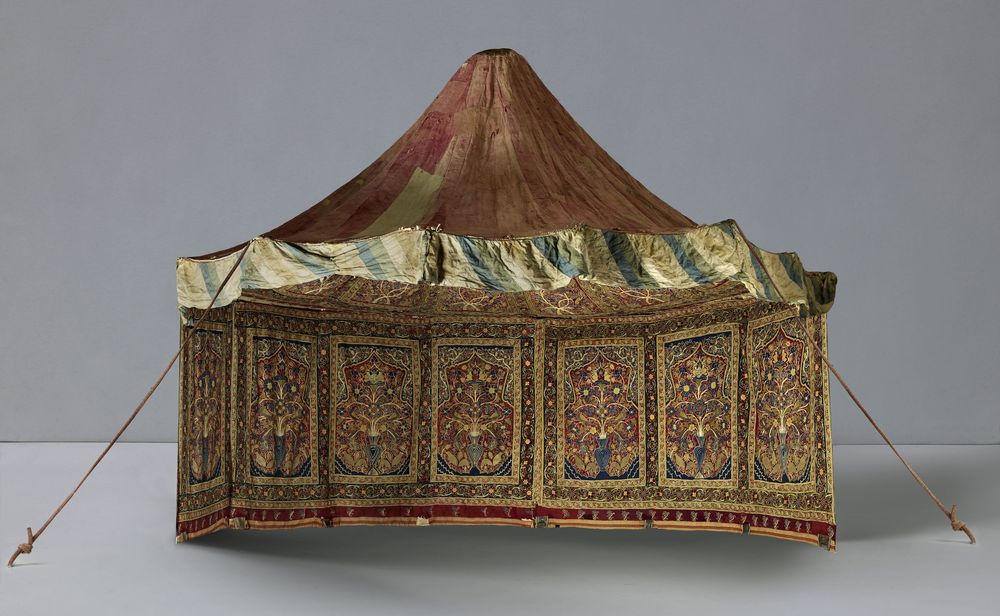
Note: this panel has significant similarities with several panels of the royal tents at the Cleveland Museum of Art, which were probably made at the same time.