Silk embroidery on flannel patchwork (military uniform cloth, hand-dyed)
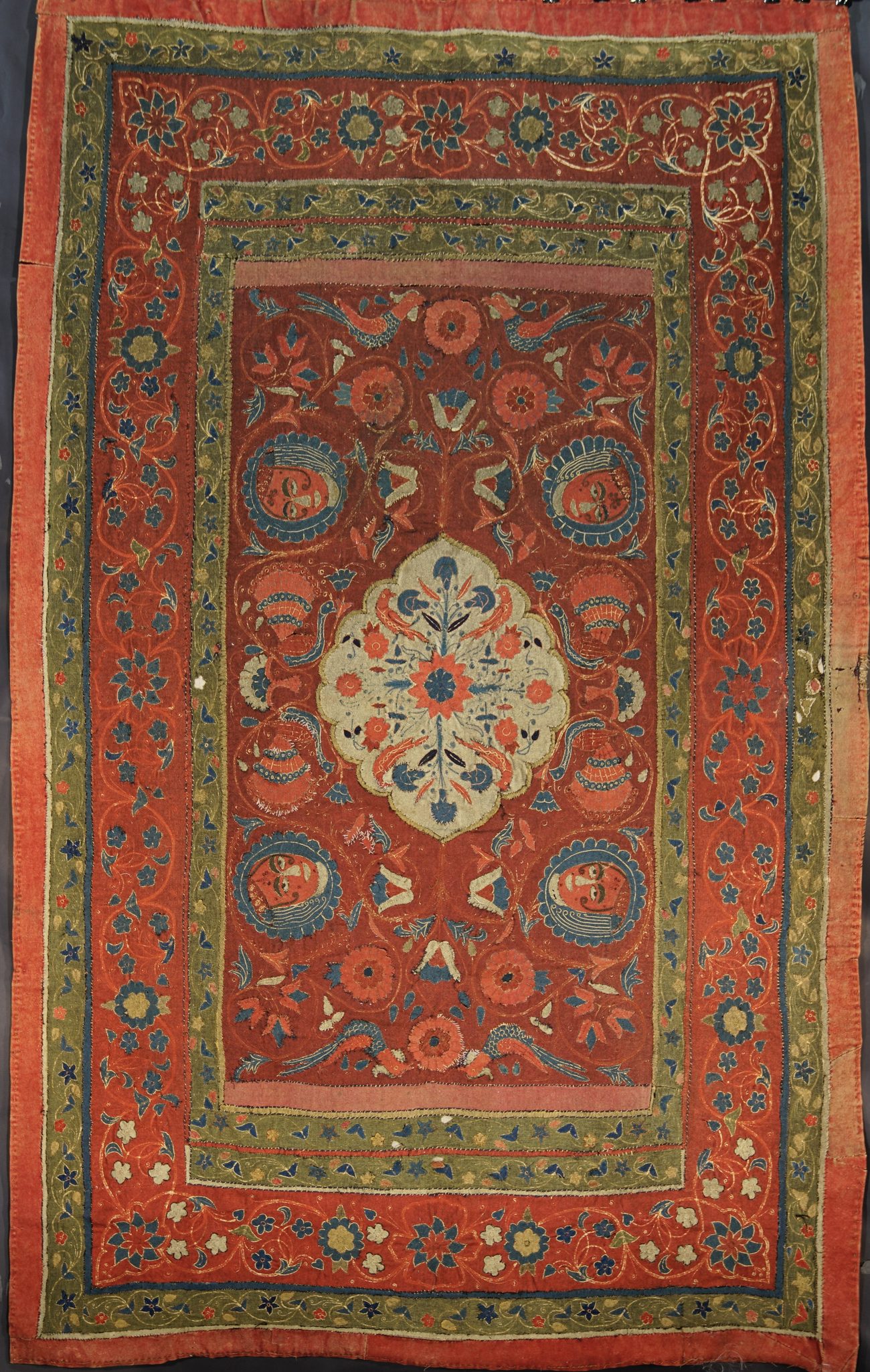
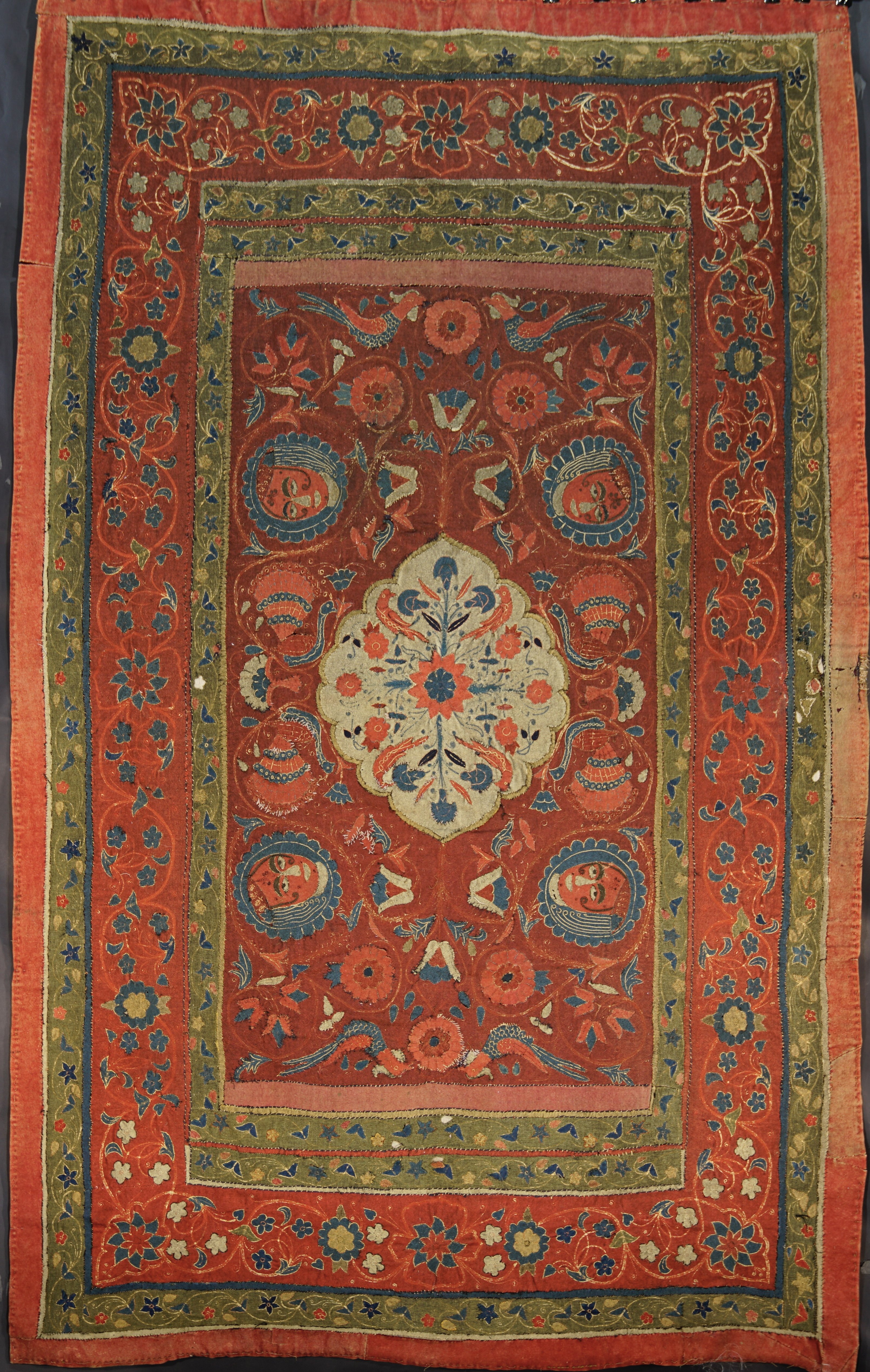
This panel is the oldest known example of Rashti-duzi in my collection, executed on original military uniform flannel. Its visible damage is not incidental—it is a testimony to its survival, though the panel has also suffered significant damage due to poor materials and mishandling. Long before commercial wool became the standard medium for professional embroiderers, early Rashti artisans repurposed inexpensive, olive-green military cloth. The resulting imperfections and wear capture the raw, utilitarian origins of a craft that would eventually evolve into an imperial luxury.
The Ascent of a Martyr
At the end of the Safavid dynasty’s rule in the early 18th century, there was significant persecution and a massacre of Sufis in both the Persian and Ottoman empires. Then, after a period of greater tolerance toward Sufism during the rule of the Zand and Qajar dynasties, Sufi artists and writers started to glorify the martyrs of the past. This panel is a result of that feeling. The panel presents a portrait of the head of a person of foreign origin, probably a high-ranking Sufi who was martyred. Through several symbols, the artist expresses that he was a martyr devoted to the divine, a messenger, and a leader who reached the highest level of purity of the ego and ascended to paradise.
Click to enlarge
The Panel
A Portrait in Silk and Memory
The Main Composition
Moving from the top to the center of the main section, two hoopoe birds are depicted, symbolizing a leader and a messenger (referencing Attar’s The Conference of the Birds). Three red roses signify love and devotion to the divine. Three red tulips with blue centers represent martyrdom and mourning, while three poppies in white, red (shaped like a heart), and blue symbolize the subject’s martyrdom and character—white for purity, and the red heart for a lovely life with a tragic, sorrowful ending. Finally, a peacock is shown ascending to paradise; according to tradition, the peacock was a heavenly bird exiled to Earth that forever longed to return to paradise to achieve ultimate unity. Throughout, Fath’Ali Sr. repeats the number three — three roses, three tulips, three poppies — reflecting its importance in Sufism as the symbol of the path to divine unity.
The Medallion
The medallion’s base color is white, symbolizing purity and righteousness. At its center is a red rose with a blue middle, which represents the divine. This center is surrounded by three fully open pomegranate flowers on each side, four silent birds, and three blue carnation flowers at both the top and bottom.
"I died as a mineral and became a plant, I died as a plant and rose to animal, I died as an animal and I was Man. Why should I fear? When was I less by dying?"
— Rumi
Comparative Works
Reference Images
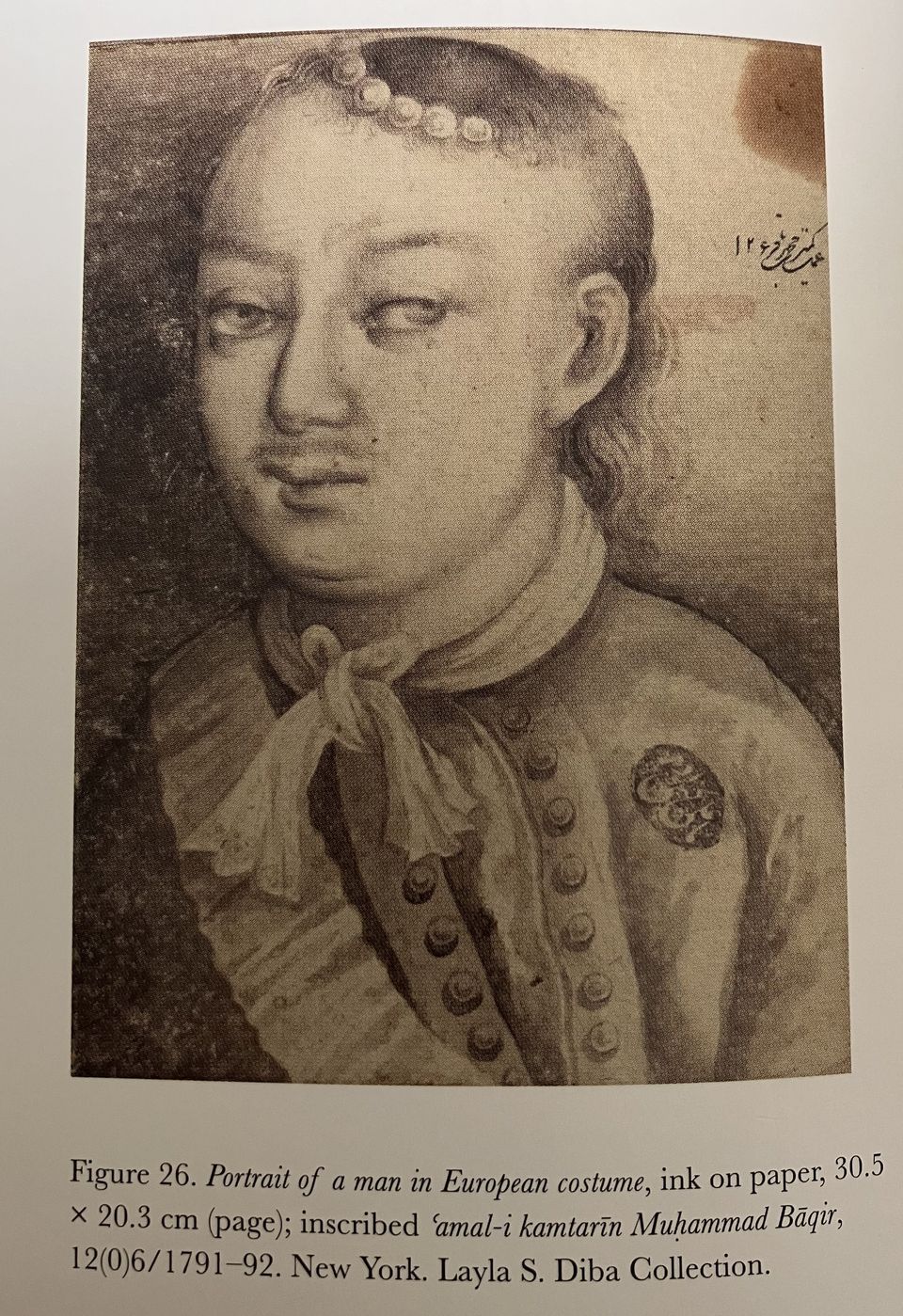
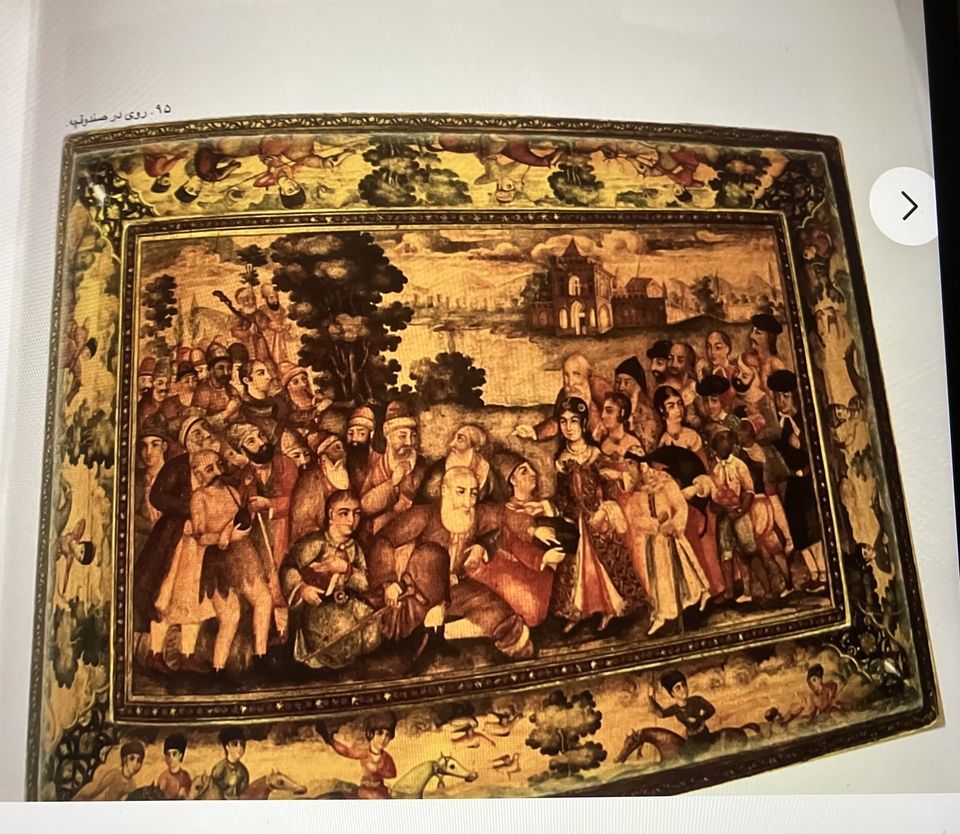
The identification of the portrait as a Sufi martyr of foreign origin is supported by two reference works that share iconographic and stylistic features with this panel.
🖼️
Drawing by Mohammad Baqer Court painter of the Zand dynasty Date: 1791–1792
baqer-drawing.jpg
Drawing by Mohammad Baqer, court painter of the Zand dynasty (1791–1792). A portrait with shared iconographic features that helps identify the subject of this panel.
📦
Lacquer painting — box lid Unknown painter Date unknown
lacquer-box.jpg
Lacquer painting on the lid of a box by an unknown painter. A second comparative portrait that, alongside the Mohammad Baqer drawing, supports the identification of the subject.
About Mohammad Baqer
Mohammad Baqer was a prominent court painter active under the Zand dynasty (1750–1794), one of the great periods of Persian portraiture. His work belongs to a tradition of highly naturalistic court painting that depicted both royalty and eminent religious figures with psychological precision. A drawing dated 1791–1792 — roughly thirty years before this panel was made — that shares the facial features and iconographic setting of the central portrait suggests that both the drawing and the embroidery depict the same individual, or at minimum the same type of venerated Sufi figure.
The connection is significant: if Fath’Ali Sr. referenced a Zand-era court drawing, it implies the subject was already memorialized before the panel was made, and that Fath’Ali Sr. was working within an established tradition of honoring this particular martyr across multiple media.
Essay
In Memory of a Martyr
Listen
Among the works in this collection, this panel holds a special place: it is the oldest example of Rashti-Duzi in my collection — the chain-stitch embroidery of the city of Rasht — and the earliest known work of the artist Fath’Ali Khomami Sr. Made around 1820–1830, it is at once an act of mourning, a covert memorial, and a statement of faith.
Its humble material tells the first part of the story. The panel is worked not on fine commercial wool but on repurposed military uniform flannel — the cheap, dense, olive-green army cloth that the earliest Rashti embroiderers used before the craft gained court patronage. Patches of undyed olive still show along the border. The visible wear and damage are not flaws to be apologized for; they are a record of the work’s age and survival, evidence that we are looking at the very beginning of a tradition.
The subject is a martyr. At the end of Safavid rule, Sufis were persecuted and massacred across the Persian and Ottoman worlds. Under the later Zand and Qajar dynasties tolerance returned, and Sufi artists began to honor the martyrs of the past. This panel grew out of that impulse. It presents the portrait of a figure of foreign origin — most likely a high-ranking Sufi who was put to death. In Qajar Iran, where orthodox clergy and Sufi orders were often at odds and prominent masters were executed, such a man could not be mourned openly. He could be remembered only through art. This panel may be exactly that: a memorial disguised as decoration, the one safe form his remembrance could take.
The imagery turns that grief into meaning, drawing on one of the great texts of Persian literature. Attar’s Conference of the Birds, written around the twelfth century, tells of the soul’s journey to God as a flock of birds seeking their divine king — led by the hoopoe, and ending in the dissolution of the self in the divine. The panel is built from that poem’s language. Two hoopoes appear as leader and messenger. Three red roses stand for love and devotion to God; three red tulips with blue hearts for martyrdom and mourning; three poppies — white, red, and blue — for purity and for a beautiful life with a sorrowful end. At the center, a medallion on a white ground of purity holds a single red rose, the divine, ringed by open pomegranate flowers, silent birds, and blue carnations.
For a Sufi viewer, placing these symbols on a martyr’s memorial made a quiet theological argument: the man’s death was not an interruption of his journey but its completion. The composition mirrors itself left to right, so that every emblem of grief is doubled — a balanced, deliberate image of mourning rather than a cry of despair.
Seen beside Fath’Ali Sr.’s later work, the panel reveals an artist still finding his way: rawer in its materials, more direct in its sorrow, yet already literary in its ambition. He would become one of the most thoughtful embroiderers of the Qajar period, choosing his subjects from the finest Persian poetry and theology. Here, at the very start, he had already grasped what his art could do — not merely to decorate, but to remember.