Reading the Panel
About the Panel
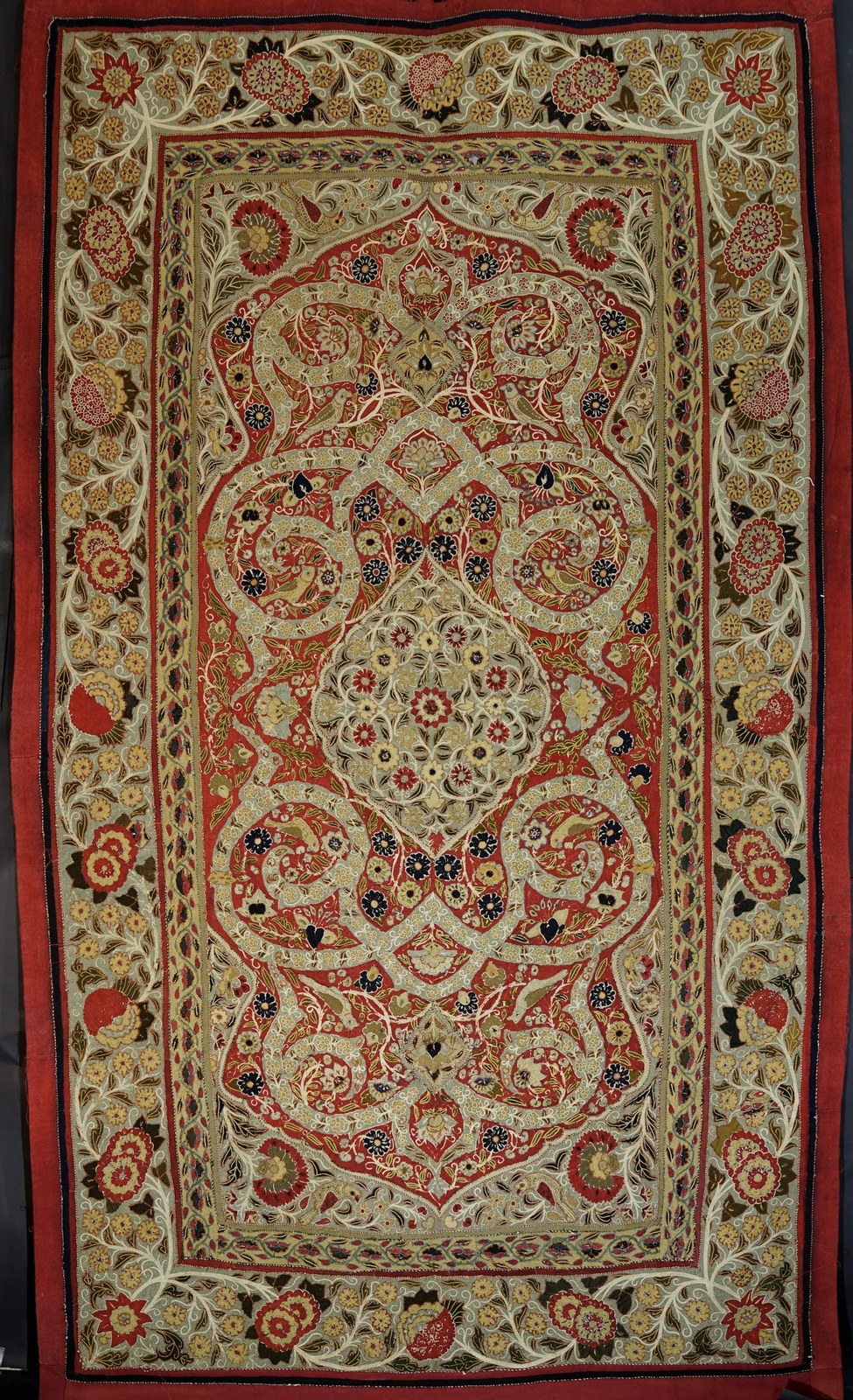
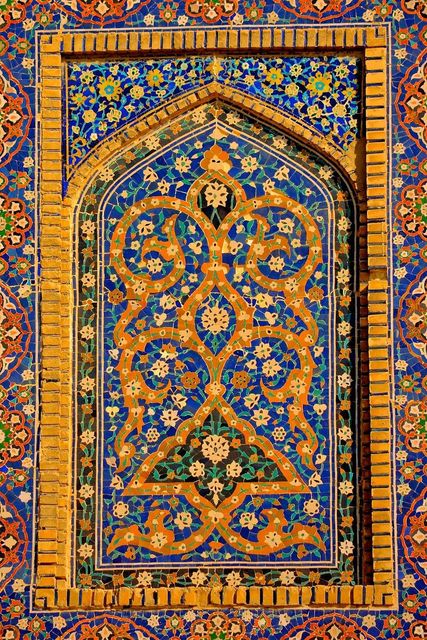
This panel tells the story of a merchant and his beloved parrot. It turns on three figures: the caged parrot, who stands for the seeker; the merchant, who provides worldly comfort and pleasure; and the wild parrot, who acts as the master teacher — the source of guidance.
The composition is divided into three sections — the three acts of the story, the central medallion, and the borders — and all three carry the same message through different characters.
The Three Acts
The first section unfolds in three acts: the parrot in its golden cage, the wild parrot feigning death, and the freeing of the caged parrot.
Much of the panel's design is built from a band resembling snake skin, carrying motifs of beauty and pleasure. The snake serves two purposes. First, because it sheds its skin each year, it is a symbol of renewal and transformation. Second, its skin is patterned and beautiful yet its bite is venomous — an image of worldly pleasures that carry disastrous consequences.
Act One
The parrot sits within a closed band of snake skin. Around it, in that enclosed space, bloom symbolic flowers that describe its character: the pomegranate (the sweetheart), the daisy (innocence), the rose (loveliness), and the cherry (sweet and beautiful). This is the parrot in its golden cage, enjoying the hospitality of its owner.
Act Two
At the top and bottom of the panel appears a parrot of a different colour, shown upside down — the wild parrot — surrounded by three cherry blossoms (a sign that nothing lasts long), cherry fruits (sweet and beautiful), and a five-layered pomegranate flower (the master teacher). This is the wild parrot feigning death to send its message: the way to the caged parrot's freedom.
Act Three
The parrot rests on a branch among symbolic flowers and bunches of grapes. Some flowers are half-open (transformation), others fully open, with the pomegranate in full bloom (reaching the highest level of the spirit). The grapes carry their own meaning: just as the fruit must be crushed to yield juice, and the juice must change to become wine, so a person must pass through great hardship — even death — to reach freedom.
The Medallion
At the centre is a large rosette (the divine), ringed by circles of symbolic flowers — tulips, roses, pomegranates, and daisies — that voice the spiritual dimension of the story. On either side of this meditative centre, the three stages of the grape's transformation are repeated.
The Borders
As noted in the Overview, a path runs through the borders, winding past different symbolic flowers. It repeats the same message: that freedom demands hardship — even death — and the guidance of a leader, the master teacher.
"The body is a cage, the soul a bird — it longs for the orchard, not the golden bars."
— Jalal ad-Din Rumi, Masnavi, Book I
Poetry — an Iranian Tradition
Poetry is deeply rooted in Iranian culture — present from the very first day of life. When a child is born, the mother takes the infant in her arms and whispers a poetic lullaby to soothe it. From that moment on, through weddings, birthdays, and celebrations, and through times of mourning and protest, composing and reciting poems remains part of Iranian tradition.
There is even a game built on it, called mosha‘ereh. Two players challenge each other to see who has memorized more poetry: one recites a line, and the other must answer with a line that begins with the last letter of the line just spoken. The contest continues until one player can no longer come up with a verse.
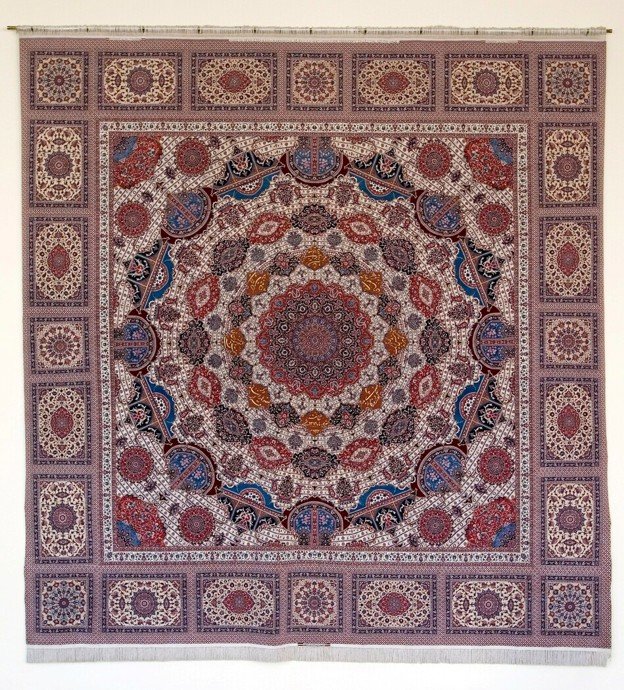
Iran’s poets, past and present, are part of the national heritage and are celebrated like public figures in Iranian society. Some Persian poems have even reached the international stage. The most famous is woven into a carpet that hangs at the United Nations: Bani Ādam (“Children of Adam”), by the 13th-century Persian poet Saadi of Shiraz. Its message is addressed to the whole world — that we are one body, and that the pain of any one of us is the pain of us all. It is a message that still needs to be heard today.