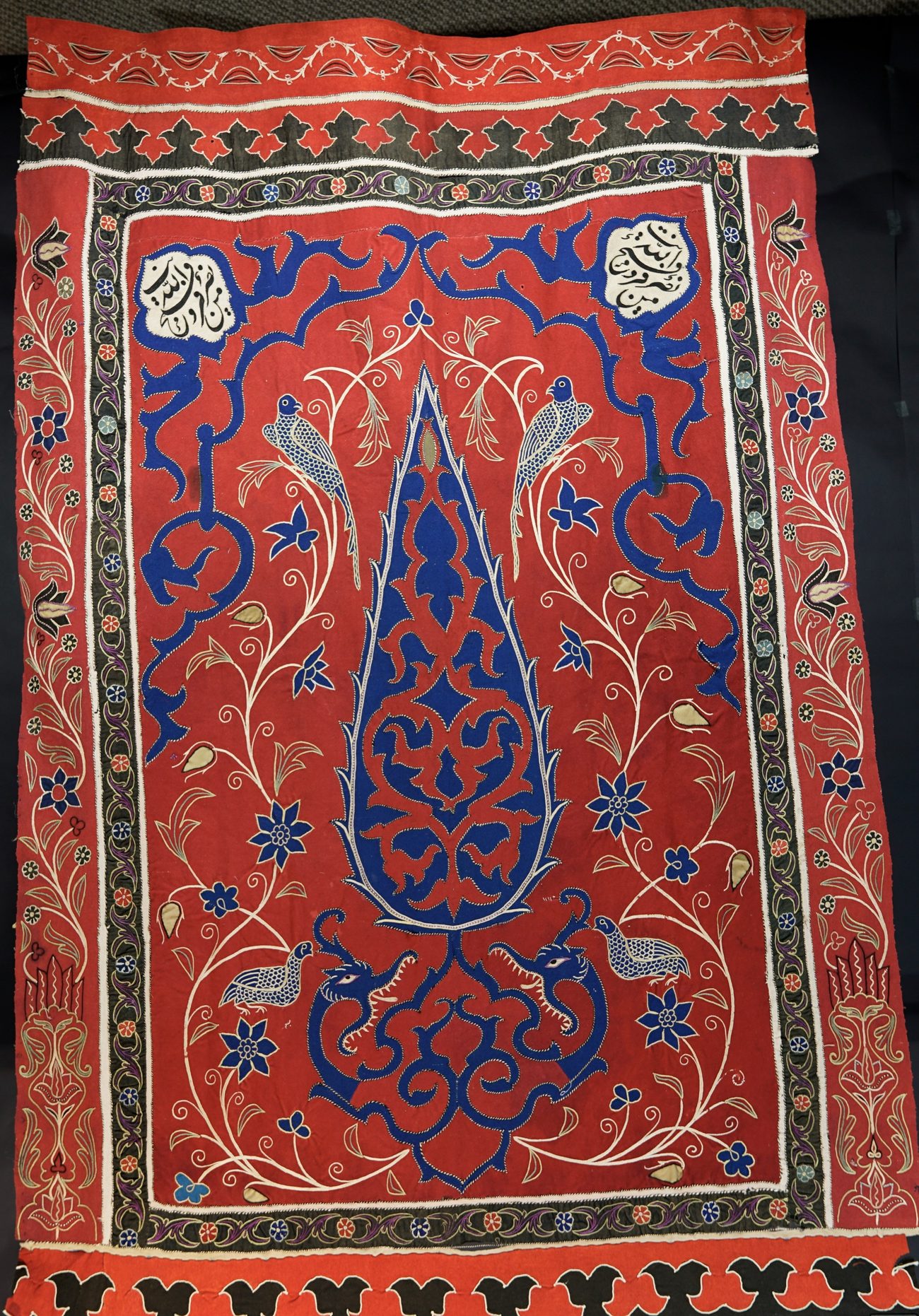
Flannel and silk cloth base · silk thread embroidery · three-color palette: bloody red, dark blue, white
The design of this panel influenced later generations of Rashti embroidery artists, who adapted its visual language to express their own ideas about war, grief, and resistance.
⚔️Possibly the earliest known anti-war artwork in Persian visual history — comparable to Picasso's Guernica, created nearly a century earlier.
The Resilience of a Nation
Following defeats in the two Russo-Persian Wars of 1804–1813 and 1826–1828, which cost Iran significant territory in the Caucasus, a profound feeling of loss and sadness swept the nation. Fath'Ali Sr. created this panel to express these feelings. The artwork is divided into two parts—the main composition and its borders—dominated by bloody red, dark blue, and white tones. The panel highlights the evils of war driven by greed and materialism, through which a piece of the nation was lost. Yet, it also emphasizes that this ancient nation is resilient and perfect; despite the sacrifices of fallen heroes and the loss of territory, hope remains if the people keep their faith. Ultimately, righteousness will always overcome selfishness and greed, and victory will be near.
"نصر من الله و فتح قریب" — With God's help, victory is near.
Quran 61:13 — the verse Fath’Ali Sr. embroidered in Arabic on both sides of the panel, the same verse carried as a war banner
🐉
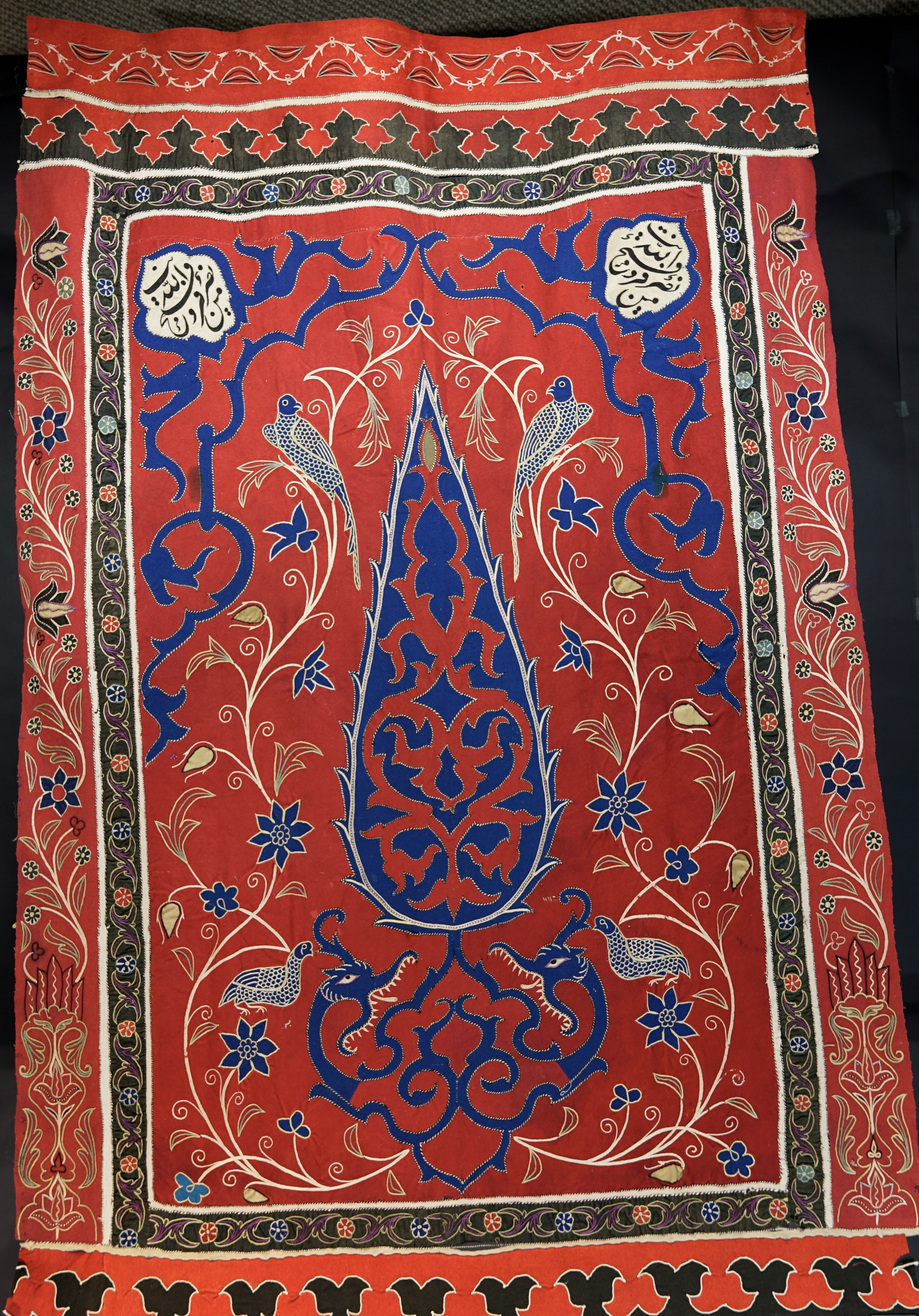
panel-2.jpg
Click to enlarge
The Panel
A Canvas of Darkness and Hope
Following defeats in the two Russo-Persian Wars of 1804–1813 and 1826–1828, which cost Iran significant territory in the Caucasus, a profound feeling of loss and sadness swept the nation. Fath’Ali Sr. created this piece of art to express his feelings. The artwork consists of two parts—the main central composition and its borders—dominated by three primary colors: bloody red (the blood of martyrs), dark blue (mourning), and white (purity).
The Main Composition
Reading the panel from the bottom center up to the top:
The Base Elements: At the bottom sits a blue vase, flanked by a partridge on each side. Drawing from Attar’s The Conference of the Birds, the partridge hoards shiny objects and jewels in its nest, making it a symbol of the greed and materialism that caused the war. The blue vase itself represents the nation, while the cypress tree rising from it acts as the nation’s soul.
The Dragon: A dark blue dragon with an open mouth, sharp teeth, and angry eyes symbolizes the evils of war, shown attempting to consume a portion of the vase (representing the lost territory).
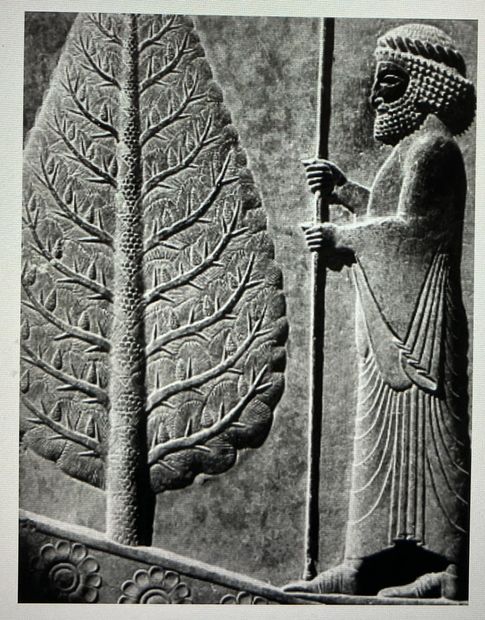
The Cypress Tree: The blue cypress represents perfection (in its flawless form), resilience (withstanding droughts and storms), and antiquity (living for centuries), serving as an enduring symbol since pre-Islamic Persia. Here, it denotes an ancient, perfect nation that remains resilient despite historic storms, though it is now in mourning. Inside the cypress is a geometric pattern traditionally used by Sufis for spiritual awakening, which Fath’Ali Sr. modified to express martyrdom and hope.
The Vertical Progression: Ascending from bottom to top inside the tree are three inverted red tulips (representing fallen heroes), a heart enclosing two hanging red tulips (symbolizing love, sacrifice, and patriotism), and a candleholder with a flaming candle (symbolizing hope).
The Borders of the Tree: The vase and cypress are framed on both sides by a white path adorned with alternating pomegranate flowers and tulips, representing a journey toward purity and faith. Two silent birds flank the path, matching its white and dark blue colors (the color of mourning).
The Top Cartouches: In the upper corners are two text panels containing an Arabic verse written in the Persian script. Translating to “With God’s help, victory is near”, this phrase is a direct verse from the Quran.
The Borders
Parts of the panels on both sides of the borders are missing.
The Side Borders: On each side is a candleholder holding five flaming candles, symbolizing the five pillars of Islam and Sufism. Rising from the heat of these candles is a path of alternating narcissus flowers and tulips, with the tulips finishing at the very top. This arrangement depicts the struggle between narcissism and righteousness, signaling that the righteous will ultimately win.
The Top and Bottom Borders: These sections feature red and black tulips, symbolizing fallen heroes and national mourning. At the very top, motifs of trenches act as barriers and barbed wire, explicitly representing the battlefields.
Storytelling
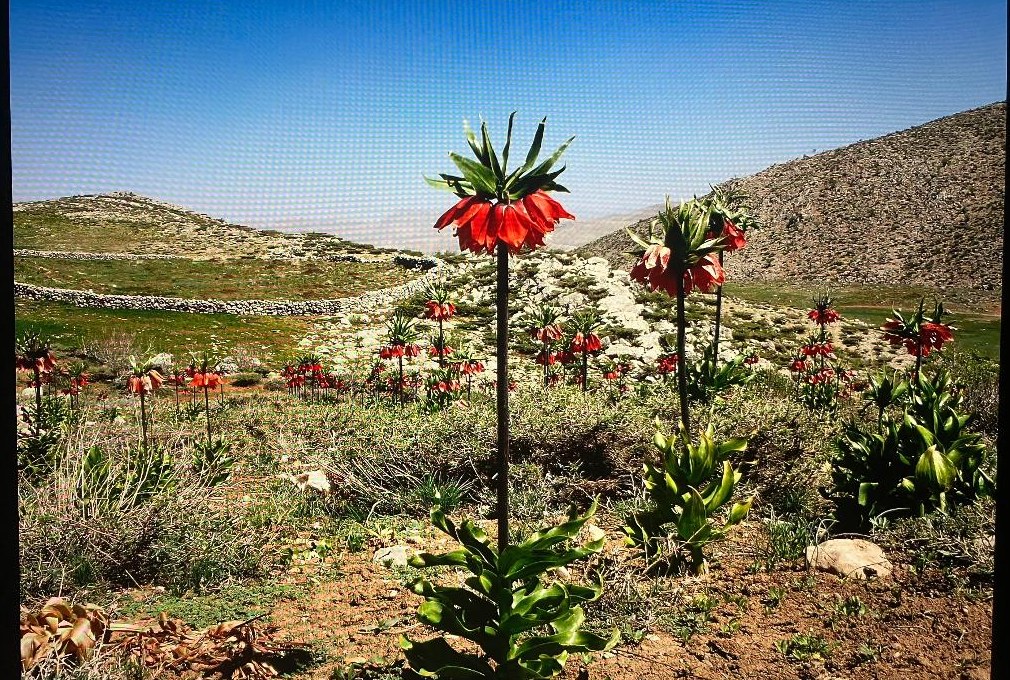
Storytelling is deeply rooted in Iranian culture. Each family used to have a few storytellers. As a child, in my family there was a tailor who moved through our family circle for repairs, alterations, and professional ironing. When he came to our house, all the children sat around him, and he would tell stories about the history of our family and tales from Ferdowsi’s Shahnameh. Another storyteller was a cook whose specialty was religious history. But the most important traditional storytelling took place in tea houses, with professional actors who performed the Shahnameh epics. The favorite acts were the stories of Rostam and Sohrab, the battle of Rostam and the White Demon, and the death of Siyâvash — an innocent prince of Iran who was killed, and from the drops of his blood grew plants with red flowers. For this reason, the red tulip in the field is, in Iranian mythology, a symbol of innocence, sacrifice, and martyrdom.
Fath’Ali Sr. expressed this story through his iconic motifs. He drew on the Shahnameh several times to convey his feelings — one example being his casting of Fath’Ali Shah as Kay Kavus, who betrayed Abbas Mirza in the Iran–Russia war just as Kay Kavus betrayed Siyâvash.
Crown imperial (Fritillaria imperialis) — in Iranian folklore its blood-red flowers bow their heads and weep for the blameless Siyâvash, and it is called Khune Siyâvushan, “the blood of Siyâvash.” Photo: Mosquito / Tearflowers.
Click to enlarge
Conclusion
Like the most prominent artists, Fath’Ali Sr. took a historical event and used it to express deep feeling — and executed it about as well as it could be done. The result is an iconic work of art.
Originality — His inspiration came entirely from the richness of Persian art, literature, and culture, to which he added his own newly invented iconic motifs.
Progressive — The panel introduces a style new to Persian art of its time, unseen before the Qajar period; Fath’Ali Sr. was a front-runner of that new style. Looked at closely, its colors and design still feel modern today.
The Memorial — By covering the panel with tulips — the red tulip is the sign of the martyr — in varied colors (red, dark blue, and black) and shapes, he created a whole field of tulips and laid the fallen heroes to rest beneath it.
Comparison — Can Fath’Ali Sr. be measured against celebrated Iranian and world artists? A single panel makes that hard to judge, but his other Rashti-Duzi works and paintings suggest he was far ahead of his time. In Iran he might be set beside Nima Yushij in poetry or Saba in music; internationally, his symbolism and inventiveness recall Picasso, and his color and motif design recall Matisse — a century before them.
A message to Iranian artists: may the style and iconic motifs of this panel — and of the panels to come — inspire today’s artists to continue the path of Fath’Ali Sr. and those who followed him: a path rooted in originality and Iranian heritage.
Comparative Works
A Century Before Guernica
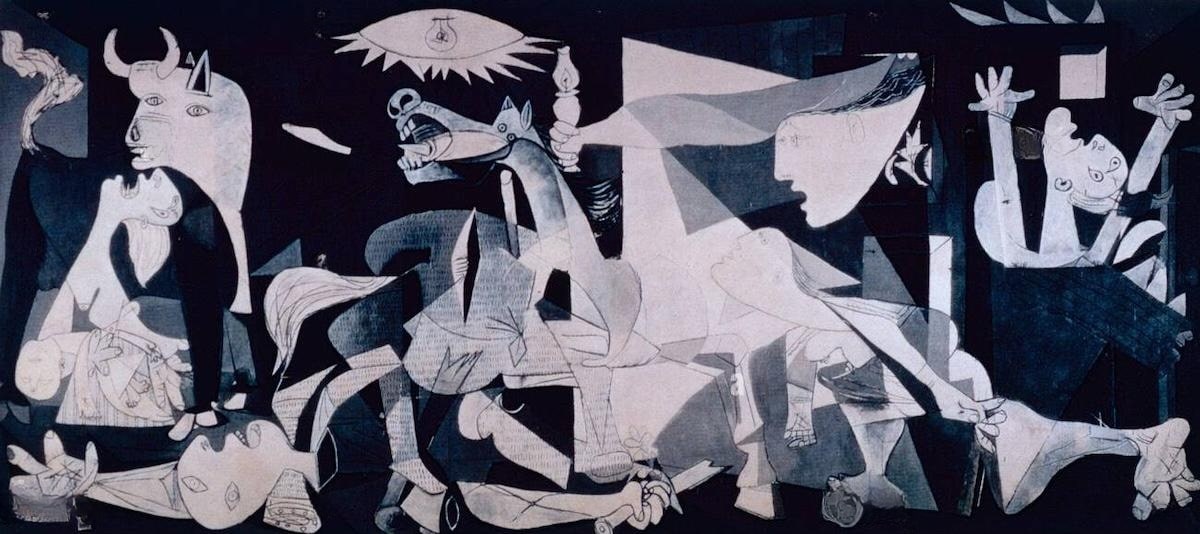
Picasso completed Guernica in 1937, using gray, white, and black — the colors of a newspaper photograph of horror. Fath’Ali Sr. completed this panel roughly a century earlier, using bloody red, dark blue, and white. Picasso used the bull and horse, symbols rooted in Spanish culture. Fath’Ali Sr. used the dragon, cypress, and tulips — symbols rooted in Persian culture. Both men were saying the same thing about war, across a century, from opposite ends of the world.
Fath’Ali Sr. and Picasso — A Century Apart
Two artists, two cultures, two wars — one conversation about what war does to the human soul.
Fath’Ali Sr. · c. 1835–1840
Iran-Russian Wars · Colors: bloody red, dark blue, white · Symbols: dragon, dark blue cypress, tulips, Quranic verse · Medium: silk embroidery on flannel · City: Rasht, Iran
Click to enlarge
Picasso · 1937
Spanish Civil War · Colors: gray, white, black · Symbols: bull, horse, broken sword · Medium: oil on canvas · City: Madrid, Spain
Click to enlarge
Essay
Tragedy of War and Hope
Listen
This panel may be the earliest anti-war work of art in Persian visual history. Embroidered in Rasht around 1835–1840 by Fath’Ali Khomami Sr., it responds to a national wound: in two wars against Russia, fought within a single generation, Iran was defeated and lost vast territory in the Caucasus. A deep sadness settled over the country, and Fath’Ali Sr. — who did not fight, but lived in a Caspian city through which wounded soldiers and refugees passed — set out to give that grief a form. The result invites comparison with Picasso’s Guernica, which it precedes by nearly a century.
Like Guernica, it is not a battle scene but a meditation on what war does to a people. Three colors carry its meaning throughout: bloody red for the blood of martyrs, dark blue for mourning, and white for purity.
The panel is meant to be read from the bottom upward. At its base stands a blue vase — the nation — flanked by two partridges. In Attar’s Conference of the Birds the partridge hoards jewels in its nest, and here the bird stands for the greed and materialism that drove the war. From the vase rises a dark blue dragon, open-mouthed and furious, caught in the act of biting away a piece of the vessel: the territory Iran lost.
Out of the same vase grows a blue cypress, the soul of the nation — an ancient Persian symbol of perfection, endurance, and great age, a tree that survives droughts and storms and lives for centuries. Here it is a resilient nation in mourning. Within its form, Fath’Ali Sr. took a geometric pattern Sufis used for spiritual awakening and reshaped it to speak of martyrdom and hope. Rising inside the tree, in order, are three inverted red tulips for the fallen, a heart holding two tulips for love and sacrifice, and — at the summit — a candle in its holder, burning: hope. Framing the vase and tree on both sides, a white path strewn with alternating pomegranate flowers and tulips marks a journey toward purity and faith, watched over by two silent birds in white and mourning-blue, their heads turned to look back.
The borders complete the message. Down each side, a candelabra of five flames stands for the five pillars, and a path of narcissus and tulips enacts the struggle between vanity and righteousness, the tulips winning at the top. Along the top and bottom run red and black tulips for the fallen, and — unmistakably — motifs of trenches and barbed wire, the battlefields themselves. In the upper corners, a Quranic verse promises what the whole work reaches toward: “With God’s help, victory is near.”
That is the panel’s quiet argument. It mourns without surrendering to despair. Fath’Ali Sr. covered the surface with tulips — the red tulip is the sign of the martyr — until it became a whole field, and laid the dead to rest beneath it, with a flame of hope kept burning above.
The work is also a statement about art itself. Its imagery comes from Persian poetry, faith, and tradition, to which Fath’Ali Sr. added motifs of his own invention — trenches and dragons that had never before belonged to this craft. The style was new to Persian art of its time, yet its colors and design still feel modern. Two artists, two cultures, two wars: a century before Picasso, an embroiderer in Rasht was already asking what war costs the human soul.