Flannel base · silk embroidery · Type One Embedded
Materials
Flannel base patchwork with twisted silk thread chain stitching
Subject
Stained-glass window design
Composed in the form of a Qajar stained-glass window — an architectural element that cast jewel-toned light through south-facing rooms of palaces, mosques, and affluent homes. Here the window becomes a garden of symbols.
Persian Original (Rumi)
بیا، بیا
بیا بیا که بهار آمد و گلها شکفت در باغ بیا که گل انار برشکفت شمع و می و یار آمد نیایی — هیچ نیست بیایی — هیچ نیست
دیوان شمس تبریزی · جلالالدین محمد رومی
English Translation
Come, come
Come, come — for spring has arrived and the flowers have bloomed Come to the garden — for the pomegranate blossom has opened Candle and wine and the beloved have come If you do not come — it does not matter If you come — it does not matter
Divan-e Shams-e Tabrizi · Jalal al-Din Muhammad Rumi
Reading the Panel
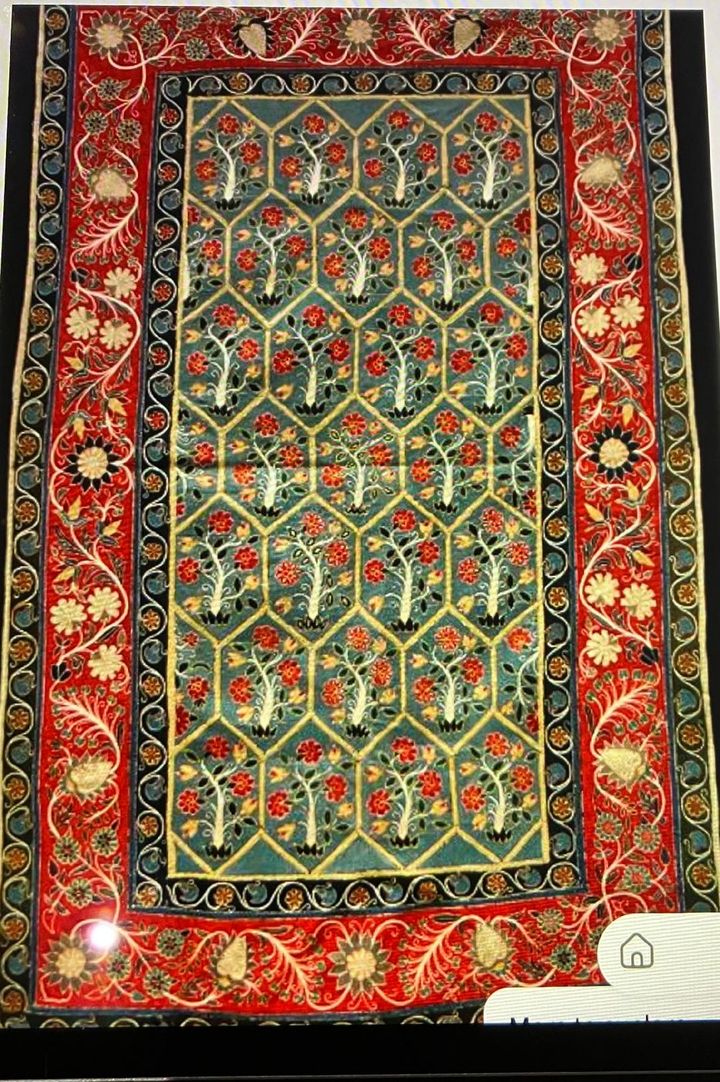
The panel is divided into two parts: the main field and the borders.
The main field is a pattern of joined hexagons designed like a stained-glass window. Each hexagon rests on one of two background colors — beige or dark blue — and holds a pomegranate plant worked to the same design, with its flowers and fruit shown at different stages of growth, so that together they form a pomegranate orchard.
The borders carry several motifs that stand for spring, the candle, the wine, and the beloved, along with birds and tulips. Read together, they form an invitation: come to the orchard, where candle, wine, and the beloved await among the pomegranate blossoms. If you come, the orchard is lit by your presence — and so the orchard’s own presence does not matter. If you do not come, the orchard stays in darkness — and still its presence does not matter.
The Composition
A Window That Is Also a Garden
The sixth panel in Fath’Ali Sr.'s known series takes as its governing form something borrowed from architecture rather than nature: the stained-glass window of Qajar palace and mosque design. Yet the panel transforms the architectural into the botanical. Its dominant imagery — pomegranate blossoms and tulips in varied colors and stages of bloom — speaks the language of the orchard and the Sufi garden, while its structure maintains the geometric order of leaded glass.
The Inspiration
Rumi's Orchard Poem
This panel may be associated with one of Rumi's most celebrated lyrics from the Divan-e Shams-e Tabrizi — the short poem beginning Biyā, biyā (Come, come). The poem is an urgent invitation: come to the orchard in spring, for the pomegranate blossoms have opened; candle and wine and the beloved have all arrived. If you come, all is well; if you do not, nothing is lost — the orchard blooms whether or not you are there. The panel's dominant floral imagery evokes the poem's celebration of renewal, beauty, and spiritual longing.
The Form
The Stained-Glass Window
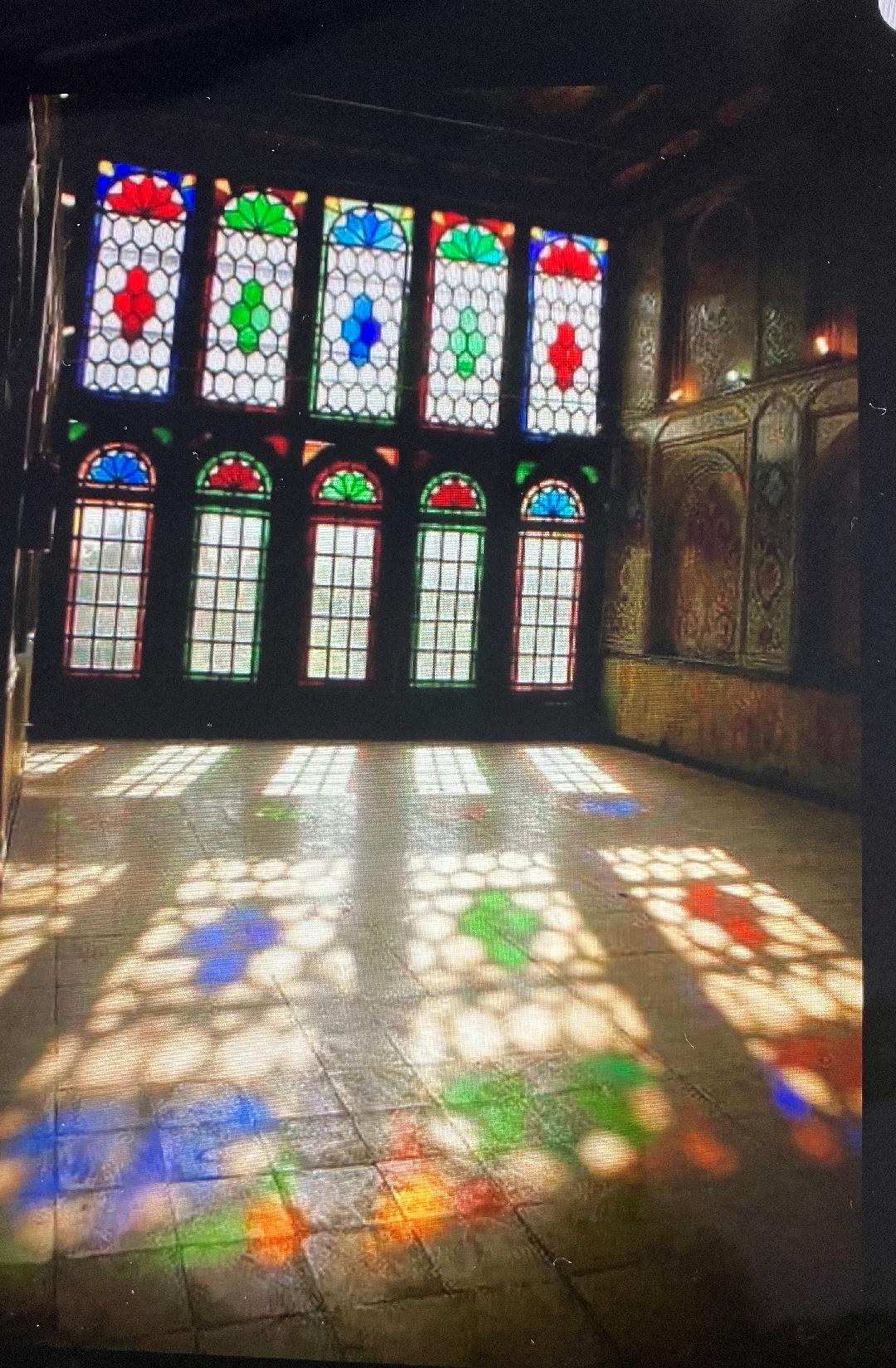
In Qajar architecture, stained-glass windows — orsi — were a principal decorative feature of south-facing reception rooms. They filled interiors with shifting colored light, created a sense of privacy without heavy curtains, and produced an atmosphere that early visitors compared to being inside a jewel. Fath’Ali Sr. transposes this architectural form into embroidery: the leaded geometry becomes the structure of the composition, and each pane of colored "glass" is filled not with plain color but with flowers bearing Sufi meaning.
The floral stained-glass design transforms the interior image into a symbolic garden, reinforcing themes of beauty, contemplation, and spiritual presence.
The window as a garden; the garden as a threshold
The Symbolism
Two Colors, Two States
The composition is organized around two principal colors. Yellow and beige are associated here with illumination — the quality of light that streams through the window and the light of divine presence in Sufi thought. Black is linked to fanā: the annihilation of the self, the dissolution of individual identity in the presence of God — the darkest moment that precedes the greatest light. These two colors do not oppose each other; they are consecutive stations on the same path.
The Reading
Unity Through Flowers
Throughout the panel, pomegranate blossoms appear in varied stages of bloom — bud, half-open, fully open — suggesting the gradual unfolding of spiritual realization. Where pomegranate flowers are superimposed upon tulips, the composition suggests tawḥīd: oneness, the merging of two sacred symbols into one. The overall reading moves from beauty and longing (the orchard in spring) toward unity and dissolution (the final merging with the beloved), echoing the arc of Rumi's poem. An alternative reading interprets the full panel as an evocation of the final stage of Sufi ascent toward unity.
Click the image to enlarge
Reading the Panel
The Orchard
The central field is a mesh of joined hexagons in dark blue and beige, and within each hexagon grows a pomegranate plant whose flowers appear at every stage of blooming — together they form a pomegranate orchard in spring. The pomegranate is no ordinary plant here: with its flowers it is a sacred symbol, long present in Iranian painting and poetry, and as a fruit it holds a special place in Iranian culture. Its flower’s progression — from a closed bud to a split-open fruit — becomes a metaphor for the soul’s journey from unawakened sleep to the mystic’s ultimate goal: baqā, subsistence in the Divine. And so the orchard carries the poem’s paradox: if you come, the light of your presence fills it and nothing else matters; if you do not come, darkness fills it — and still nothing matters.
The Borders
The border has three parts: a main band with a narrow band on either side of it. The two narrow bands are filled with split-open pomegranates set in alternation.
The main band carries the symbols of the poem. Three yellow daisies stand for spring (in Persian, gol-e bahār). The pomegranate flowers carry the rest: one with blue, heart-shaped petals is the sweetheart; one with a red-and-blue base and vivid red petals is the wine; and one with a beige-and-grey base and red petals is the candle. A bird set among a tulip and a pomegranate flower is an invitation to fly to a higher spiritual station. And a multi-tiered beige crown — a layered pomegranate flower shown at different stages of bloom, flanked by a pair of tulips — stands for the Divine, the highest level of the spirit.
So, in spring, the pomegranate flowers hold candle, wine, and the beloved. The border complements the central field and unfolds the poem’s meaning: if you come to the orchard, it will be lit by your presence, and so the orchard itself does not matter; if you do not come, it stays in darkness — and still the orchard does not matter.
The Garden — an Iranian Tradition
The garden is deeply rooted in Iranian culture and has an ancient history. When Cyrus the Great returned from Babylon, he set out to create a garden at Pasargadae to rival the beautiful ones he had seen there. Water was diverted from the mountains to irrigate it, and the layout he devised — a garden divided into four quarters, known as the chahār bāgh — survives to this day. Because it was easy to irrigate and move through, and because a reflecting pool lay at its heart, the design was copied by architects and artists throughout history — seen, for example, in the gardens of the Taj Mahal and the Alhambra, and in the Persian carpet itself.
Gardens and flowers are woven through Iranian life and art. They appear in courtyards and alleyways, along sidewalks, in carpets and poetry, in people’s names and in symbols — and in countless other places besides.
At the Persian New Year — Nowruz, the first day of spring and the rebirth of nature — flowers are everywhere, including on the haft-sin table; and on the thirteenth day of spring, Iranians celebrate nature out in the gardens.
In creating an orchard in this panel — and a rose garden in others — Fath’Ali Sr. gave this tradition a form of its own: an original work of Persian art.
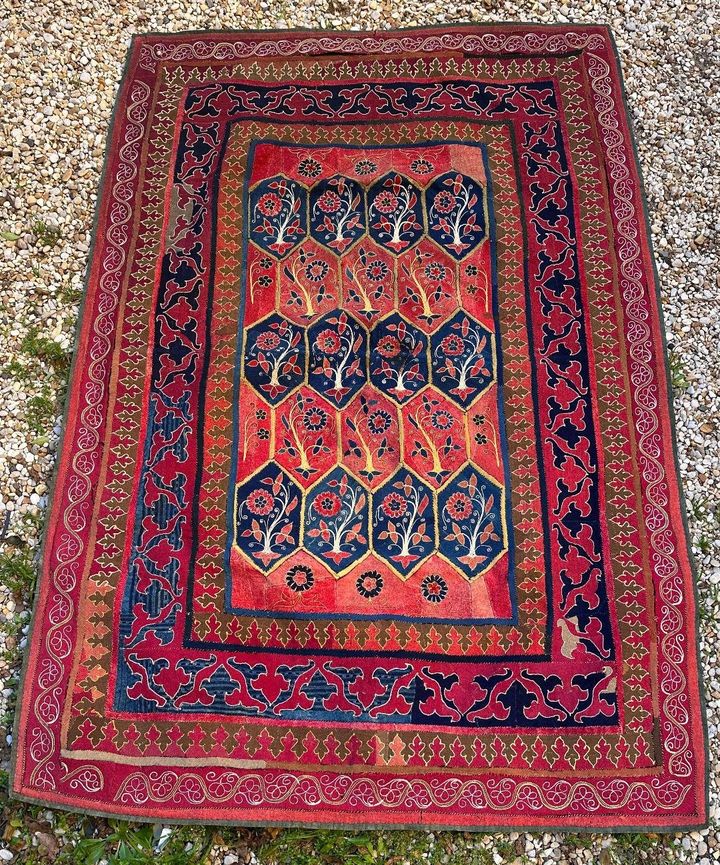
Rose Garden — Farmand gallery
Click an image to enlarge
Visual Program
Border Motifs and Their Meanings
The borders of this panel function as a commentary on the central stained-glass composition — elaborating, repeating, and deepening the themes of the interior field. Each motif group carries a distinct symbolic valence within Fath’Ali Sr.'s established vocabulary.
1
Corner & border centers · beloved
Large Pomegranate Blossom with Heart Core and Yellow Petals
At each corner and at the center of the borders, a large flower with a heart-shaped core and yellow petals appears. This modified pomegranate blossom is interpreted as a symbol of the beloved — the divine beloved of Sufi devotion. Two tulips flank each of these blossoms, their paired presence suggesting a guard of honor or a frame of devotion around the most sacred element.
2
Wine · divine ecstasy
Modified Pomegranate Flower with Vivid Red Petals
A second variant of the pomegranate flower, rendered with vivid red petals, carries the symbolism of wine — not literal wine but the Sufi concept of spiritual intoxication, the state in which the mystic's longing becomes so intense that ordinary consciousness dissolves. Red in Fath’Ali Sr.'s vocabulary consistently signals the most ardent devotional states and the willingness for sacrifice.
3
Awakening · joy · creative light
Three Yellow Daisies
Three yellow daisies serve as emblems of awakening and joy — the quality of light and creative energy that corresponds to the yellow of the main window's illumination. Daisies, with their radiate form, are natural solar symbols; yellow intensifies this association. The number three echoes the recurring sacred triad throughout Fath’Ali Sr.'s work: here perhaps morning, noon, and evening light; or body, mind, and spirit brought into alignment.
4
Absolute devotion · sacred longing
Bird Gazing Toward Pomegranate Blossom and Tulip
A bird turning its gaze toward the two sacred flowers — pomegranate blossom and tulip — may be read as a symbol of absolute devotion to the divine. In this interpretation, the bird does not merely observe the flowers but is wholly oriented toward them, as the mystic soul is wholly oriented toward God. Both the pomegranate blossom and the tulip carry particular sacred significance within Sufi imagery; together they form an object of complete contemplation.
5
Upper & lower edges · unity · purity
Pomegranate Flowers Superimposed on Tulips, with White Tulips
At the upper and lower edges of the central panel, pomegranate-flower motifs are superimposed upon tulips — two sacred symbols merged into one form, suggesting tawḥīd: oneness and unity, the ultimate goal of Sufi practice. White tulips placed to either side introduce an association with purity — the whiteness of the soul that has been emptied of self in preparation for divine union.
6
Inner & outer borders · visual program
Repeated Pomegranate-Flower Motifs
Pomegranate-flower motifs repeated along both the inner and outer borders emphasize the central importance of this flower within the panel's visual program. The pomegranate blossom — gol-e anar — is the flower Rumi names in the poem: gol-e anār barshekoft (the pomegranate blossom has bloomed). Its repetition across the entire border system frames the composition as an act of extended praise for this single flower, and by extension, for the beloved it represents.
Yellow / Beige
Illumination — the quality of light that streams through the window, and the light of divine presence. Associated with the creativity and joy of awakening.
Black
Fanā — the annihilation of the self, the dissolution of individual identity before God. The darkness that precedes the greatest light.
Red / Vivid
Wine and divine ecstasy — not literal intoxication but the spiritual state of longing so intense that ordinary consciousness dissolves. Sacrifice and ardent devotion.
White
Purity — the whiteness of a soul emptied of self, prepared for union with the divine. White tulips signify this readiness.
Rumi · Divan-e Shams-e Tabrizi
The Poem at the Heart of the Panel
The short lyric below — one of the most direct and joyful in Rumi's vast Divan — is the verbal counterpart to this panel's visual program. It is an invitation: come to the orchard, the blossoms have opened, the occasion has arrived. Whether you come or not, the poem suggests, may ultimately matter less than the beauty of what is waiting.
Persian Original (Rumi)
بیا، بیا
بیا بیا که بهار آمد و گلها شکفت
در باغ بیا که گل انار برشکفت
شمع و می و یار آمد
نیایی — هیچ نیست
بیایی — هیچ نیست
دیوان شمس تبریزی · جلالالدین محمد رومی
English Translation
Come, come
Come, come — for spring has arrived and the flowers have bloomed
Come to the garden — for the pomegranate blossom has opened
Candle and wine and the beloved have come
If you do not come — it does not matter
If you come — it does not matter
Divan-e Shams-e Tabrizi · Jalal al-Din Muhammad Rumi
Line by Line
"Come, come"
The doubled imperative — biyā, biyā — sets the tone of the whole poem: urgent but not anxious, insistent but strangely serene. It is the call of someone who has already arrived and wants you to share what they are seeing. The repetition is musical, a refrain before the refrain begins.
The Image
"The pomegranate blossom has opened"
Rumi's specific choice of flower — the pomegranate blossom — is the hinge of the poem, and the flower that dominates Fath’Ali Sr.'s panel. The pomegranate is deeply embedded in Persian poetry and Sufi imagery as a symbol of the beloved, of the heart (its interior chambers and seeds), and of the sweetness that is only accessible after the exterior shell is broken. The blossom — the moment before the fruit — represents the opening of possibility.
The Paradox
"If you do not come — it does not matter / If you come — it does not matter"
The poem's final two lines are among the most radically Sufi statements in Rumi's Divan. At first they seem to contradict the urgency of the opening invitation. But in Sufi understanding, this is the voice of the soul that has gone beyond attachment to outcomes — even to the beloved's arrival. The garden blooms whether or not anyone enters it. The divine beauty exists regardless of the mystic's ability to perceive it. This is the freedom of tawakkul: total trust and surrender.
Historical Context
The Qajar Stained-Glass Window
To fully appreciate Panel #6, one must understand the architectural form it transposes into cloth — and the cultural world in which that form carried such weight.
The Stained-Glass Windows of Qajar Architecture
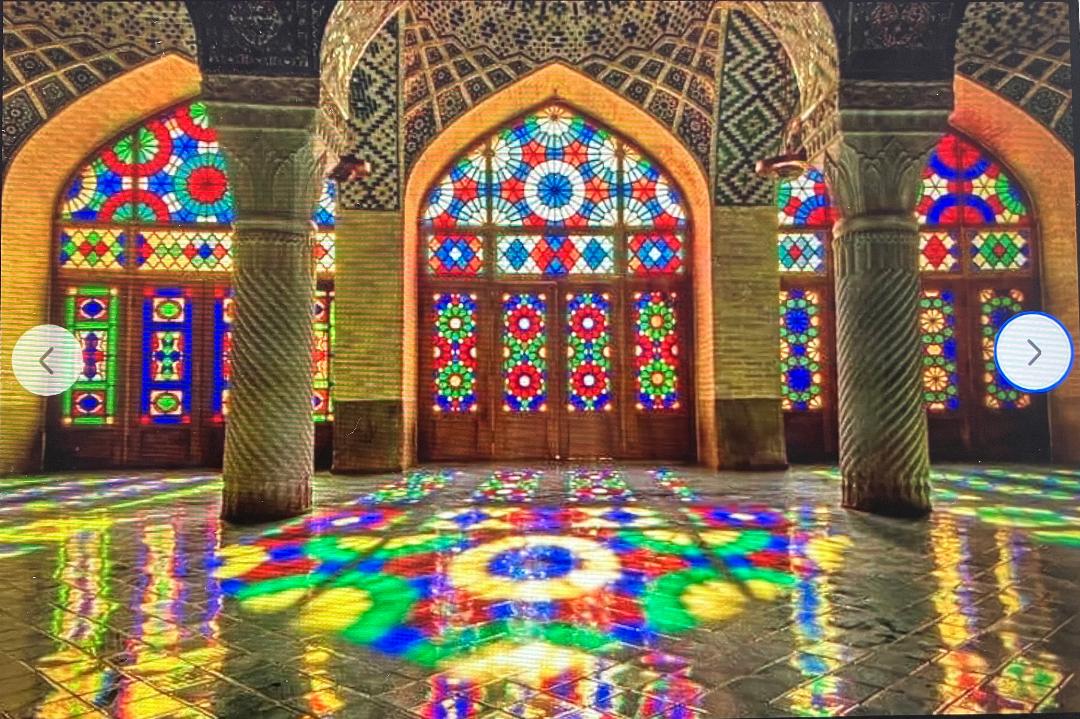
In Qajar-era domestic and civic architecture, stained-glass windows known as orsi were a defining feature of the most distinguished interiors. Typically installed in south-facing rooms — reception halls, private chambers, and the great porticos of palaces and affluent homes — these windows served multiple functions simultaneously.
Most visibly, they cast warm, multicolored light across carpets, tiles, and furnishings throughout the day, creating an interior atmosphere of shifting color and luminosity. The effect was compared by European visitors to standing inside a jewel. Beyond their visual richness, orsi windows also provided privacy: the patterned glass obscured interior views while remaining translucent, and they protected furnishings and textiles from the bleaching and fading effects of direct sunlight.
The windows are composed of colored glass pieces held within a wooden lattice — typically geometric or floral in pattern — in a technique that shares its fundamental logic with Western stained glass but developed independently within the Persian architectural tradition. Their designs frequently incorporated floral motifs — roses, tulips, pomegranate blossoms — that resonated with the garden imagery so central to Persian poetry and Sufi thought. To enter a room lit by an orsi window was, in a sense, to enter a garden of light.
Orsi stained-glass windows in Persian architecture — coloured panes set in a wooden lattice scatter jewelled light across the interior.
Click the image to enlarge
The Pomegranate in Persian Art
The pomegranate (anar) is one of the oldest cultivated fruits of the Iranian plateau, present in Persian art and literature for millennia. In Islamic and Sufi contexts, its interior — hundreds of seeds enclosed in a single skin — became a natural metaphor for the Many within the One, the multiplicity of created things within the unity of God. The blossom, which Rumi names directly, represents the moment of opening: the instant before the fruit forms, when the flower is at its most luminous.
Provenance
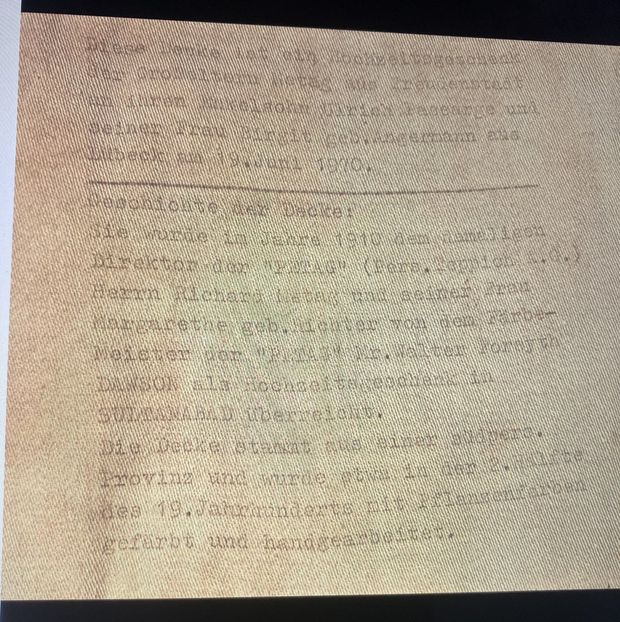
A tag sewn to the back of this panel, written in German. Translation:
Tag on the reverse · click to enlarge
This blanket is a wedding gift from the city of Immenstadt to their godson Ulrich Kasserge and his wife Birgit née Angermann from Lübeck on June 19, 1970.
History of the blanket: It was presented in 1910 to the then-director of “PETAG” (Pers. Teppich A.G.), Mr. Richard Latzig, and his wife Margarethe née Richter by the dyeing master of “PETAG”, Mr. Walter Forsyth Dawson, as a wedding gift in Sultanabad.
The blanket originates from a southern province and was handmade and dyed with vegetable dyes approximately in the second half of the 19th century.
Essay
A Window That Is a Garden
Listen
Constructed like a window, this panel from 1835–1840 is modeled after the orsi—the magnificent stained-glass windows of Qajar palaces and mosques. Traditionally, these wooden-framed windows filled rooms with a soft, jewel-toned glow, leading people to say that sitting in their presence was like sitting inside a garden of light. Fath’Ali Khomami Sr. took this architectural concept and gave it a brilliant twist: instead of glass, he filled the geometric panes with embroidered flowers. The window became a living sanctuary.
At the center lies a honeycomb of linked hexagons set against deep blue and beige backgrounds. Inside each cell grows a pomegranate plant depicted at every stage of blooming, creating a vibrant spring orchard. In Persian art, the pomegranate carries profound symbolic weight. Its countless seeds, held tightly within a single skin, represent the vast multiplicity of the world gathered within one God. Furthermore, the way the blossom opens—from a closed bud to a split-open fruit—mirrors the journey of the human soul waking from spiritual sleep to achieve final union with the Divine.
A tripartite border frames this sacred orchard, adorned with split pomegranates and layered symbols that read like a visual poem. Groups of three yellow daisies announce the arrival of spring. A pomegranate flower with blue, heart-shaped petals represents the Beloved; a brilliant red bloom evokes the symbolic wine of spiritual ecstasy; and a third signifies the illuminating candle. Nearby, a bird perched beside a tulip invites the viewer’s spirit to rise higher, while a crown-like motif flanked by tulips honors the Divine. Together, these elements declare that in the springtime of the soul, the candle, the wine, and the beloved exist simultaneously.
This entire visual landscape springs from a short poem inspired by Rumi. It functions as a direct invitation to enter the orchard where spiritual treasures await, yet it concludes with a striking riddle: whether you come or stay away does not matter. Fath’Ali Sr. stitched this exact paradox into the fabric. If you come, your internal light illuminates the space, making the external orchard secondary. If you stay away, the garden remains in darkness, yet its intrinsic value is unchanged. The beauty does not rely on human validation; it resides simply in its own being.
The garden remains one of the oldest and most sacred images in Iranian culture, woven into courtyards, carpets, poetry, and the annual Nowruz spring table. By condensing the vastness of a garden into an embroidered window, Fath’Ali Sr. elevated a humble domestic craft into an architecture of profound meaning. Nearly two centuries later, the panel extends the same quiet, timeless invitation: to step through a window of thread into a sanctuary that blooms continuously, whether or not anyone arrives to see it.